Annual appraisals no longer work. By the time you review an employee’s performance once a year, the goals have shifted, the feedback is outdated, and the best performers have already started looking elsewhere.
Performance management software fixes this by replacing the once-a-year review with a continuous cycle of goal setting, feedback, and development. This guide compares the 12 best options available in India in 2026 with features, pricing models, and a clear view of which tool suits your company size and industry.
What Is Performance Management Software?
Performance management software is a digital tool that helps you set employee goals, track progress, collect feedback, and run appraisal cycles from one platform. It replaces manual review forms and disconnected spreadsheets with a structured, automated process. Modern PMS tools support:
Support OKRs and KRAs
Enable 360-degree multi-rater feedback
Allow continuous check-ins
Support performance-linked pay
Integrate with payroll and leave systems
Auto-update salary revisions and increments
Many vendors also integrate directly with payroll and leave management so that appraisal outcomes flow automatically into salary revisions and increments.
The 12 Best Performance Management Software in India (2026)
1. HR Software Bangalore
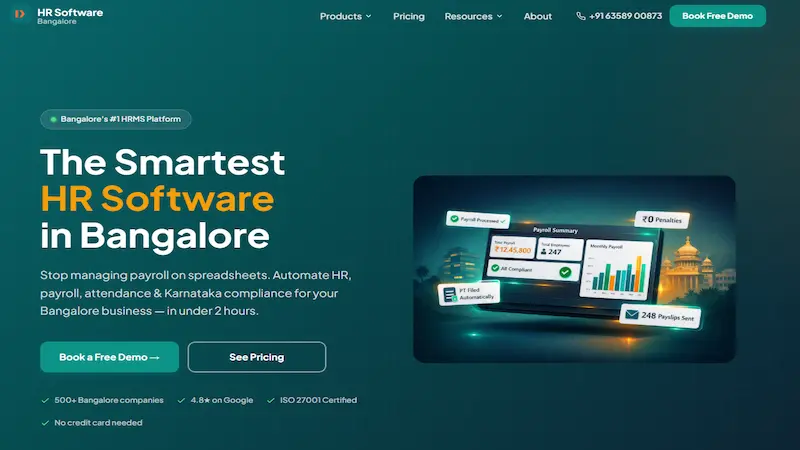
HR Software Bangalore is an automated HRMS built specifically for Bangalore and Karnataka businesses. The performance management module is integrated with payroll, attendance, and statutory compliance so that your appraisal outcomes directly influence salary and contribution calculations without any manual data transfer.
Professional Tax slabs, ESI thresholds, PF contributions, and LWF deductions are configured and updated when regulations change.
Best for: Small, medium, and large businesses that need performance management with automatic compliance handling.
2. factoHR
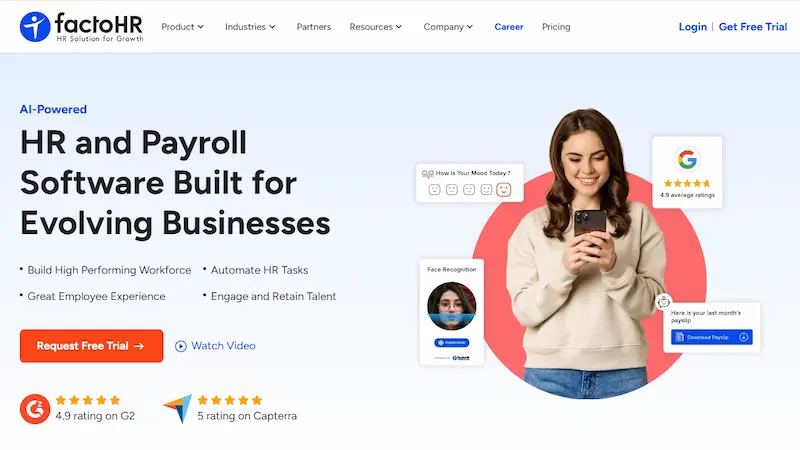
factoHR is an all-in-one hire-to-retire HRMS built for the Indian market. Its performance management module covers the full appraisal cycle and integrates directly with factoHR’s payroll and compliance engine, making it a strong choice for companies that want PMS and payroll on a single platform.
Key features:
Continuous, aligned goal setting
Flexible review cycles
360-degree configurable feedback
Performance-linked payroll automation
Score normalization across teams
Recognition and feedback tools
Pricing: Starts at ₹4,999 per month for up to 50 employees. ₹69 per employee per month for additional employees.
Best for: SMBs and mid-market companies that need PMS, payroll, and statutory compliance in one integrated platform.
3. Keka HR
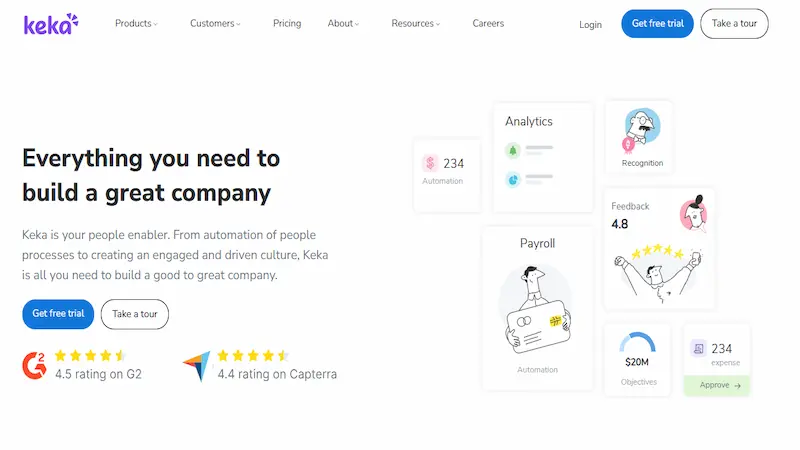
Keka is one of the most widely adopted HR platforms among tech companies. It is headquartered in Hyderabad and designed specifically for the Indian market, with a strong performance management module that suits OKR-driven engineering and product teams.
Key features:
OKRs and SMART cascading
Continuous feedback and 1:1s
Multi-perspective review cycles
Performance-linked appraisal engine
Pulse surveys and engagement tracking
Pricing: Custom pricing based on company size.
Best for: Mid-size IT, SaaS, and professional services companies looking for performance management and scalable review processes.
4. greytHR
greytHR is India’s most established cloud HR platform, founded in 2009 and trusted by over 20,000 businesses. It is best known for its payroll accuracy and depth of compliance. Its performance management module has grown significantly and now supports goal management, 360-degree feedback, and continuous reviews.
Key features:
Role-based, customizable goal setting
Gamified daily target alerts
Regular 1-on-1 feedback sessions
360-degree peer and manager feedback
Annual performance reports with history
Pricing: Starts around ₹3,495 per month for up to 50 employees.
Best for: Small and mid-size Indian businesses seeking compliant payroll with integrated PMS.
5. Darwinbox
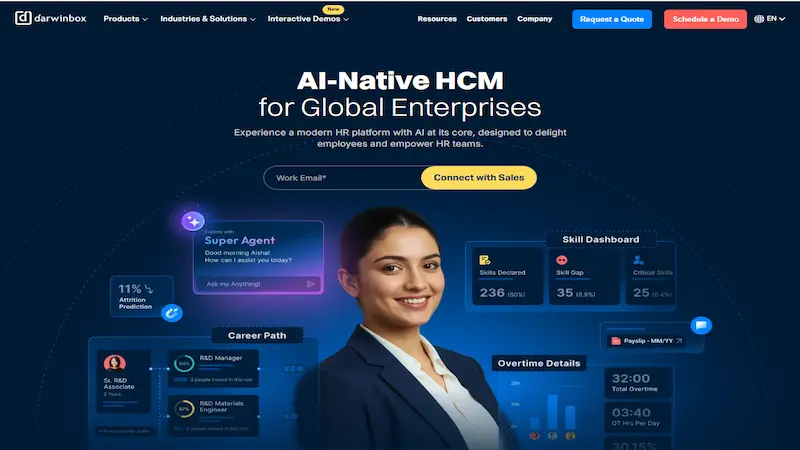
Darwinbox is an enterprise HCM platform built in India and used by large organizations, MNCs, and high-growth companies managing workforces of 500 or more. Its performance module supports multiple goal frameworks and advanced talent analytics.
Key features:
OKR and MBO goal cascading
360-degree talent profiles
Career and succession planning
Role-based dashboards
Analytics and performance trends
Pricing: On request, enterprise pricing is typically suited for large companies.
Best for: Large enterprises and Indian MNCs that need performance and talent management capabilities.
6. Pocket HRMS
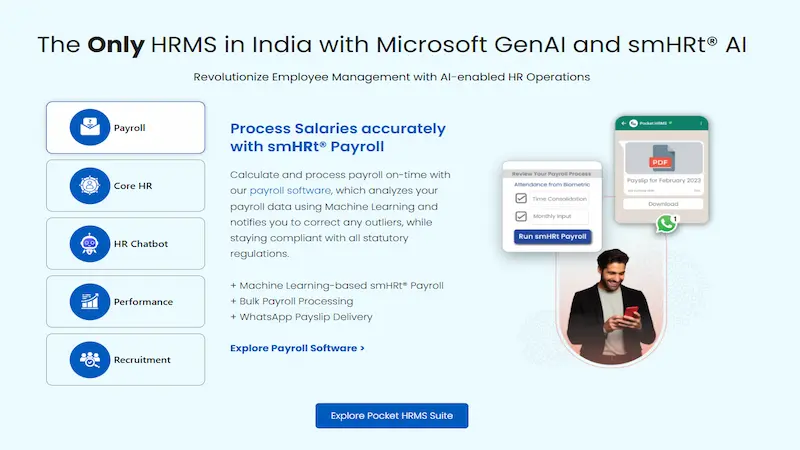
Pocket HRMS is a cloud-based HRMS with AI-driven automation, targeted at mid-size Indian businesses that need payroll, compliance, and performance management without the complexity of an enterprise platform.
Key features:
SMART goal setting and tracking
AI-driven automated review suggestions
Peer, manager, and subordinate reviews
Built-in employee recognition tools
Continuous feedback with prompts
Pricing: Starts at ₹2,995 per month, billed annually, for 50 employees, with an additional ₹60 per employee.
Best for: Mid-size companies that need an affordable all-in-one HRMS with PMS functionality.
7. HROne
HROne is a fully automated HRMS platform that emphasizes eliminating manual HR work. Its performance module is built around OKR mapping and continuous check-ins, with features designed for teams that want clear goal accountability without a heavy administrative overhead.
Key features:
OKR mapping with automated reminders
9-box talent calibration and succession
360-degree review with automated feedback
Rewards and recognition linked to performance
Workforce planning integrated with performance data
Pricing: The Basic plan costs ₹4,950 per month for 50 users, with each additional user at ₹99 per month.
Best for: Growth-stage startups and companies that want to build an OKR-driven performance culture.
8. Zimyo
Zimyo is a cloud-based HR platform focused on making performance management accessible for Indian SMBs. It takes a feedback-first approach and is designed to be easy to configure and use without a dedicated HR software team.
Key features:
360-degree feedback: self, peer, manager
SMART goal setting with tracking
Automated appraisal with templates
Culture, transparency, and feedback tools
Reports and surveys for performance trends
Pricing: Starts around ₹80 per employee per month.
Best for: Startups and small businesses that are setting up their first structured performance management process.
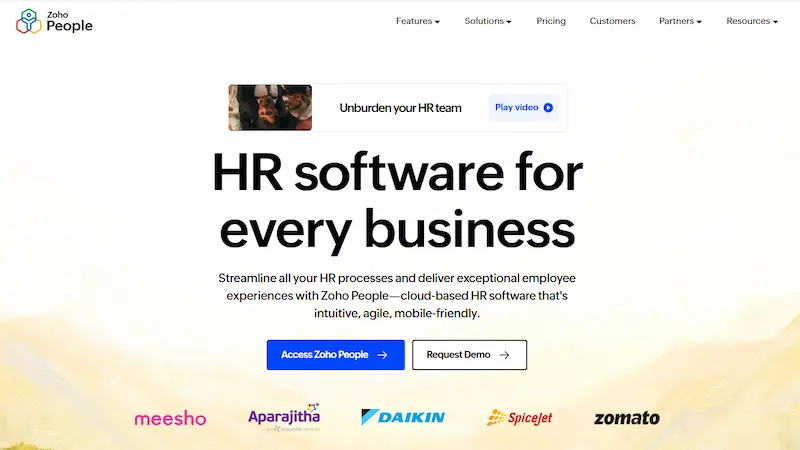
9. Zoho People
Zoho People is the HR module within the Zoho ecosystem. It offers a flexible PMS that integrates naturally with Zoho Payroll, Zoho CRM, and other Zoho business tools. If your business already runs on Zoho products, the integration advantage is significant.
Key features:
KRA and KPI goal management
9-box talent assessment and succession
360-degree multi-rater feedback
Self-appraisals and automated scheduling
Analytics and performance benchmarking
Pricing: Starts around ₹48 per user per month on the “Essential HR” plan.
Best for: Small to mid-size businesses and growing enterprises that need a comprehensive HR management system.
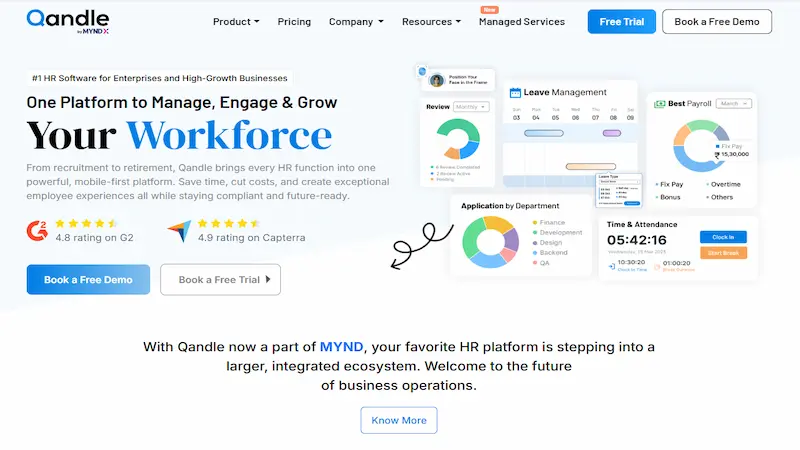
10. Qandle
Qandle is a modular HRMS that lets you activate only the modules you need. This makes it attractive for growing businesses that want performance management without paying for a full HRMS suite from day one.
Key features:
Performance benchmarking across teams
360-degree configurable feedback
SMART goals with skill-linked tracking
1-on-1 meeting scheduling and records
Employee engagement and performance tracking
Pricing: The “Foundation” plan costs ₹2,450 per month for up to 50 employees, with ₹49 per month for each additional employee.
Best for: SMBs that want a configurable platform and only want to pay for the HR modules they actually use.
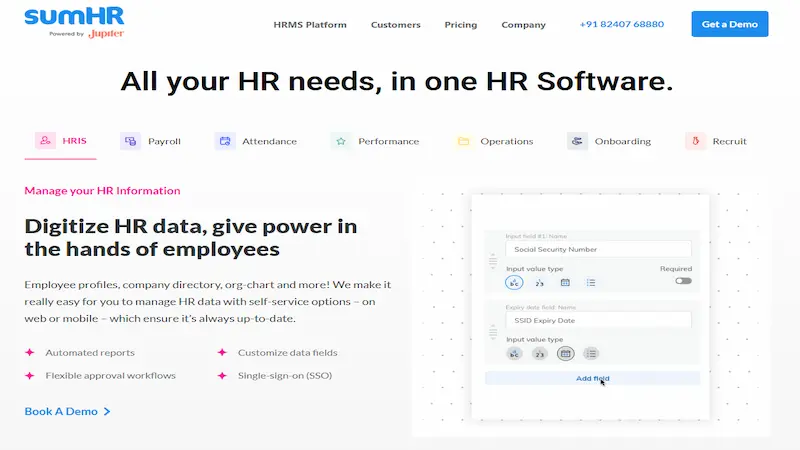
11. SumHR
SumHR is a cloud-based HR platform with a data-rich performance module that goes deeper into analytics than most tools in its price range. It suits companies that want detailed insight into individual and team performance without moving to an enterprise platform.
Key features:
Self, peer, and subordinate reviews
Flexible monthly, quarterly, and annual cycles
KRA and KPI tracking with scores
9-box talent mapping results
Spider-graph skills and development analysis
Pricing: Starts at ₹49 per user per month, billed annually.
Best for: Small and mid-size companies that want detailed performance analytics and a data-driven appraisal process.
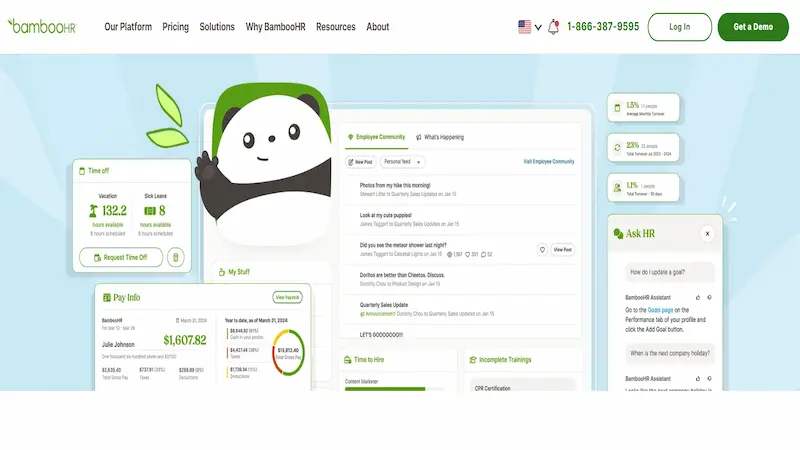
12. BambooHR
BambooHR is a US-based HRMS with a clean, easy-to-use performance module. It is widely used by Bangalore offices of global companies and by Indian startups that have international investors or global team members. Note that pricing is USD-based, which makes it less competitive for Indian SMBs without global operations.
Key features:
Frequent feedback replacing annual reviews
Customizable evaluation templates
Goal setting with tracking and reminders
Assessment reports for HR and managers
Simple employee and manager interface
Pricing: On request, USD-based.
Best for: Businesses or startups with international teams that need a globally recognized HR platform.
Tool
Best For
Starting Price
Indian Compliance
HR Software Bangalore
Bangalore and Karnataka businesses
Custom pricing based on company size
Yes
factoHR
Indian SMBs needing PMS + payroll
Rs.4,999/month for 50 employees, Rs.69/additional employee
Yes
Keka HR
Mid-size IT and SaaS companies
Custom pricing based on company size
Yes
greytHR
Payroll-first SMBs with PMS add-on
~Rs.3,495/month (50 employees)
Yes
Darwinbox
Large enterprises, 500+ employees
On request
Yes
Pocket HRMS
Mid-size companies, all-in-one HRMS
Rs.2,995/month for 50 employees, Rs.60/additional employee
Yes
HROne
OKR-driven growth-stage companies
Rs.4,950/month for 50 users, Rs.99/additional user
Yes
Zimyo
Startups, first-time PMS buyers
~Rs.80 per employee/month
Yes
Zoho People
Businesses in the Zoho ecosystem
~Rs.48 per user/month
Yes
Qandle
Modular HRMS buyers
Rs.2,450/month for 50 employees, Rs.49/additional employee
Yes
SumHR
Analytics-focused SMBs
Rs.49 per user/month, billed annually
Partial
BambooHR
Global teams, MNC offices
On request (USD)
Partial
What to Look for When Choosing PMS Software in India
Before you compare tools, decide what your business actually needs. These five criteria matter most for Indian companies.
Indian statutory compliance integration: A PMS that links to payroll needs to handle Indian statutory deductions correctly. If the tool does not handle these natively, you will have to manage them separately every month.
Goal framework support: Decide whether your teams work better with OKRs, KRAs, or SMART goals. Most Indian tools support all three, so pick the tool that matches your existing performance criteria.
360-degree feedback: Single-rater appraisals, where only the manager evaluates the employee, fail to capture an overall assessment. Look for tools that also allow self-assessment and peer reviews in the cycle.
Payroll linkage: The best PMS tools link appraisal outcomes directly to payroll, so increment and bonus calculations run automatically after a review cycle closes.
INR pricing for SMBs: Global tools are priced in USD and often require a minimum employee count that does not suit a 50-person team. Indian tools price in INR and offer flexible plans per employee per month.
Most HR tools on this list are built for a generic India audience. They handle broad compliance well but require manual configuration for state-specific rules: PT slabs, LWF deductions collected twice a year, and the Shops and Establishments Act working hour rules.
HR Software Bangalore is built from the ground up for this market. Koramangala startups, Whitefield IT companies, Peenya manufacturing units, and Electronic City BPOs all have the same Karnataka compliance baseline.
You get performance management, payroll, attendance and leave, recruitment, and statutory compliance in one platform with INR pricing and local support. You do not need to configure Karnataka PT slabs manually or call global support to explain LWF.
Ready to see performance management that works for your Bangalore team?
For small Bangalore businesses with under 100 employees, HR Software Bangalore is the strongest option. It offers INR pricing, Indian compliance support, and a performance management module that does not require a dedicated HR software administrator to configure and maintain.
Yes, most India-built tools do. HR Software Bangalore, factoHR, Keka, and greytHR all link appraisal outcomes directly to payroll and handle Karnataka statutory deductions, including Professional Tax, PF, ESI, and Labour Welfare Fund contributions.
OKRs (Objectives and Key Results) set ambitious goals with measurable outcomes, ideal for fast-moving teams updating goals quarterly. KRAs (Key Result Areas) define core role responsibilities and measure performance, and are suited to stable roles with consistent duties.
Pricing for Indian HR and performance management tools varies by company size, features, and modules. Mid-market platforms charge per employee, while enterprise solutions are customized based on headcount and selected modules.
A new employee forms their opinion of your company in the first 30 days. If they spend that time chasing HR for their offer letter copy, waiting three weeks for laptop access, or not knowing who to report to, that impression sticks.
This checklist covers every onboarding task Indian companies need to complete, from the day you send an offer letter to the end of the 90-day probation period. Use it as a working document or download it as a free template your HR team can adapt.
What Should an Employee Onboarding Checklist Include?
A complete onboarding checklist covers five phases: pre-boarding, Day 1, the first week, the first 30 days, and the 30-60-90 day milestones. Each phase has specific tasks for HR, the manager, and IT respectively.
⚠️ India-Specific Requirements
Indian companies have onboarding requirements that differ from global templates. Statutory document collection, PF and ESI registration, Form 11 for PF, and gratuity nomination forms are India-specific tasks that must be completed correctly and on time. A generic onboarding checklist will miss these.
Phase 1: Pre-Boarding Checklist (Before Day 1)
Pre-boarding starts the moment a candidate accepts your offer. Tasks in this phase prepare the employee before they walk through the door.
HR Tasks
Send the signed offer letter via email and collect digital acceptance
Share joining formalities checklist with the new hire
Set up employee ID and payroll record in the HRMS
Register the employee for PF (EPF Form 2 and 11) and ESI if applicable
Prepare appointment letter, NDA, and any IP assignment agreement
Add employee to payroll for the joining month (part-month calculation)
Set up employee profile in the self-service portal
Document Collection from New Hire
PAN Card copy (mandatory for TDS under Section 192)
Aadhaar Card copy (for KYC and PF registration)
Passport size photographs (2 to 4 copies)
Educational certificates (highest qualification)
Previous employer experience and relieving letter
Last 3 months salary slips from previous employer
Form 16 from previous employer (for current financial year TDS calculation)
Bank account details (cancelled cheque or bank statement for salary transfer)
Proof of current address
Form 11 (PF declaration for previous PF account transfer or fresh account)
IT and Admin Tasks
Order or assign laptop, access card, and any required equipment
Create company email ID
Set up access to required software and systems
Assign workstation or desk in the office
Add to relevant communication channels (Slack, Teams, WhatsApp groups)
Phase 2: Day 1 Checklist
The first day is about orientation and making the new employee feel welcome. Keep it simple. Too much information on Day 1 is counterproductive.
HR Tasks
Welcome meeting with HR: company overview, leave policy, attendance process, payroll date
Issue employment contract and collect signed copies
Collect any outstanding joining documents
Biometric or attendance system enrollment
Issue access card and office keys if applicable
Complete PF Form 2 (nominee declaration) and Form 11 signing
Manager Tasks
Team introduction (in-person or virtual)
Share 30-60-90 day goals and first-week priorities
Assign a buddy or mentor for the first month
Walk through the team structure and key stakeholders
Confirm work hours, break times, and remote work policy if applicable
IT Tasks
Hand over laptop and confirm all software access is working
Complete IT security orientation (password policy, data handling rules)
Verify VPN access if required for remote work
Phase 3: First Week Checklist (Days 2 to 5)
The first week builds the foundation for the employee’s understanding of their role, team, and how the company operates.
One-on-one with immediate manager to set expectations for the first 30 days
Introduction meetings with key cross-functional stakeholders
Product or service orientation (how does what we sell or do actually work?)
Review of all active projects or accounts the employee will support
HRMS self-service walkthrough: how to apply for leave, access payslips, submit reimbursements
Complete gratuity nomination form (Form F under the Payment of Gratuity Act)
Complete any mandatory training (POSH policy, data security, code of conduct)
Confirm bank account details are live for first salary transfer
Phase 4: First 30 Days Checklist
The first 30 days are about integration. The employee should understand their role clearly and start contributing independently.
Complete all pending statutory document submissions
Verify PF account activation (EPFO member portal)
ESI card generation if applicable
30-day check-in meeting with manager: role clarity, blockers, support needed
HR well-being check-in: settling in, team fit, any concerns
Assign and confirm completion of any role-specific training or certifications
Add employee to annual performance cycle if mid-year joining
Phase 5: 60 and 90 Day Milestones
These milestones assess whether the onboarding is working and prepare for the probation review.
60-Day Milestone
Formal feedback session: manager reviews initial performance against goals
Employee feedback on onboarding experience (what worked, what did not)
Confirm all compliance tasks are complete (PF transfer, ESI, gratuity nomination)
Identify any skill gaps and create a development plan if needed
90-Day Milestone (Probation Review)
Formal probation appraisal against agreed 30-60-90 day targets
Decision on confirmation or extension of probation
Issue appointment confirmation letter if confirmed
Update HRMS with confirmed status and applicable salary revisions
Set annual performance goals for the confirmed employee
💡 Quick Summary: Onboarding at a Glance
Pre-boarding: Offer letter, documents, PF/ESI registration, IT setup Day 1: Orientation, contract signing, PF forms, team intro Week 1: Role clarity, stakeholder intros, HRMS training, compliance forms 30 days: Statutory verification, check-in meetings, training completion 60 days: Feedback session, onboarding review, skill gap identification 90 days: Probation appraisal, confirmation letter, annual goal setting
Stop Managing Onboarding on Spreadsheets
HR Software Bangalore automates task assignment, document collection, PF registration, and probation tracking for every new joiner.
HR Software Bangalore includes a digital onboarding module that automates the entire checklist. When you create a new employee record, the system generates a task list for HR, IT, and the joining manager automatically.
Document collection happens through a secure employee portal. The new hire uploads their PAN, Aadhaar, bank details, and previous employer documents before their first day. HR reviews and approves everything from one dashboard. PF and ESI registration data is captured directly and used for filing. Learn more about our recruitment and onboarding software for Bangalore businesses.
Frequently Asked Questions
Mandatory documents include PAN card (for TDS under Section 192), Aadhaar card (for EPFO KYC), bank account details (for salary transfer), PF Form 11 (declaration for EPF), Form 2 (PF nominee), and previous employer relieving letter. Additional documents depend on the nature of the role and industry.
Statutory document collection and system setup should be completed in the first week. Full role integration typically takes 30 to 90 days depending on the complexity of the role. The 90-day period is also the most common probation period in Indian employment contracts.
A probation period is not mandated by central law in India but is widely used and recognised. Its terms must be specified in the appointment letter. Many states and industries have sector-specific rules on probation duration. Typical periods range from 3 to 6 months.
Form 11 is a declaration under the Employees Provident Funds Scheme 1952. It tells the employer whether the new employee was a member of the PF scheme in their previous job. If they were, it enables a PF account transfer. If not, it creates a fresh PF account. Every new employee must submit Form 11 at joining.
A good HRMS tracks onboarding task completion with owner assignment and due dates. HR managers see a status dashboard showing which tasks are pending for each new joiner, who owns them, and how many days are overdue. Manual spreadsheet tracking is error-prone for teams hiring more than 5 people per month.
Tracking employee attendance sounds simple until you have staff working from different locations, shifts, and devices. Choosing the wrong attendance method leads to buddy punching, disputed records, and hours wasted reconciling payroll data every month.
This guide compares the three most widely used attendance methods in India today: biometric, GPS, and selfie-based attendance. You will find out how each one works, where it fits best, and which combination most Indian businesses actually need.
What Is Biometric Attendance?
Biometric attendance uses a physical device at your office entry point. Employees scan their fingerprint, palm, or face to mark their arrival and departure. The device records the exact time and syncs with your HRMS.
This method is the most tamper-proof option for a fixed workplace. There is no proxy attendance possible because the system reads a physical trait unique to each person. Most biometric devices in India support fingerprint (most common), face recognition, and RFID cards.
Best for: Offices, factories, and any fixed-location business where all employees report to one building.
Limitations of Biometric Attendance
Requires hardware installation at every office location
Expensive to scale across multiple sites (Rs. 5,000 to Rs. 25,000 per device)
Does not work for remote employees, field staff, or work-from-home setups
Hygiene concerns around shared fingerprint scanners, especially post-2020
Maintenance and connectivity issues can cause data gaps
What Is GPS Attendance?
GPS attendance lets employees check in and out from their mobile phone. The system records their GPS coordinates at the time of check-in. You can set a geo-fence around your office or project site, so check-in is only allowed within a defined radius.
This method needs no hardware. Employees use an app on their existing smartphone. HR managers see real-time location data and attendance logs from a single dashboard.
Best for: Field teams, sales staff, delivery executives, construction workers, and multi-site businesses.
Limitations of GPS Attendance
GPS can be spoofed using VPN or location-faking apps if the system does not include identity verification
Requires employees to have a smartphone with data connection
Accuracy depends on GPS signal strength, which varies in basements and rural areas
Cannot confirm the right person checked in without a face verification step
What Is Selfie Attendance?
Selfie attendance combines a live photo of the employee with GPS location at the time of check-in. The employee takes a selfie through the HR app, the system verifies their face against the stored profile, and logs the location simultaneously.
This method addresses the biggest weakness of GPS-only systems: identity verification. You know not just where the check-in happened but who actually checked in. Modern systems use AI face-matching to flag mismatches automatically.
Best for: Remote employees, hybrid teams, field staff, and businesses wanting GPS accuracy plus identity confirmation.
Limitations of Selfie Attendance
Needs front camera and adequate lighting for accurate face matching
Some employees resist photo-based check-in on privacy grounds
Face recognition accuracy can drop with masks, glasses, or poor lighting
Requires a reasonably modern smartphone (2018 or newer for reliable AI matching)
Biometric vs GPS vs Selfie: Side-by-Side Comparison
Feature
Biometric
GPS
Selfie + GPS
Identity verification
Fingerprint or face scan
None by default
Face photo + AI match
Location tracking
Fixed location only
Yes, with geo-fence
Yes, with geo-fence
Hardware required
Yes (device at site)
No
No
Works for remote staff
No
Yes
Yes
Anti-proxy protection
High
Low
High
Cost to set up
Rs. 5,000 to Rs. 25,000 per device
App-based, low cost
App-based, low cost
Best workforce type
Office, factory
Field, delivery
Hybrid, remote, field
HRMS integration
Via API or USB sync
Real-time
Real-time
Which Attendance Method Does Your Business Need?
The answer depends on how and where your employees work. Most Indian businesses today have a mix of office staff, remote workers, and field teams, which means no single method covers everyone.
All staff in one office: Use Biometric
Field or delivery teams: Use GPS with Geo-fence
Remote or hybrid employees: Use Selfie + GPS
Large office plus field teams: Use Biometric at office + GPS or Selfie for field
Multiple office locations: Use cloud-connected biometric devices or Selfie attendance
Use biometric if all your employees work from a single fixed location and you want a fully hardware-controlled system with no smartphone dependency.
Use GPS attendance if you manage field staff, delivery executives, or project-site workers who are always on the move.
Use selfie attendance if you have remote or hybrid employees and need identity confirmation alongside location data.
Use a combination if you have different employee types. Most Bangalore businesses with 50 or more employees run biometric at the office and GPS or selfie for everyone else.
Attendance Tracking Built for Bangalore Businesses
Biometric sync, GPS check-in, and selfie attendance in one platform. No manual exports, no payroll errors.
HR Software Bangalore supports all three methods from a single platform. Office employees check in via biometric device sync. Field and remote staff use GPS check-in or selfie attendance through the mobile app. All data flows into one attendance dashboard.
The system automatically calculates working hours, late arrivals, overtime, and LOP days based on your shift policy. Attendance data feeds directly into payroll, so there are no manual exports or reconciliation steps at month end. Learn more about our attendance management software for Bangalore businesses.
Frequently Asked Questions
Biometric is more accurate for identity verification at a fixed location. GPS is more accurate for location tracking of field staff. For the strongest overall accuracy, selfie attendance with GPS combines both.
With GPS-only systems, location spoofing is possible using certain apps. Selfie attendance reduces this risk by adding face verification at the time of check-in. Systems with AI face-matching flag anomalies automatically.
Karnataka law does not mandate biometric attendance specifically. However, the Karnataka Shops and Establishments Act requires employers to maintain accurate daily attendance records for every employee. The method used is at the employer’s discretion.
Geo-fencing is a virtual boundary set around a location, such as your office or project site. GPS attendance software allows check-in only when the employee is within this boundary. You set the radius (50 to 500 metres typically) in the system settings.
Yes. Most modern biometric devices sync with HRMS platforms via API or direct integration. Attendance data automatically updates payroll calculations, including LOP deductions, overtime, and shift differentials, without manual data entry.
Ready to Set Up Attendance Tracking for Your Team?
HR Software Bangalore supports biometric sync, GPS check-in, and selfie attendance in one platform.