Most Bangalore employers know they need to follow the Karnataka Shops and Establishments Act. Few know exactly what it demands of them, and that gap is where compliance penalties come from.
This guide breaks the Act down by what it actually requires you to do: who must register, what working hours you can set, what leave your employees are owed, which registers you must maintain, and what happens if you miss any of it.
What Is the Karnataka Shops and Establishments Act?
The Karnataka Shops and Establishments Act, 1961 is a state labour law that regulates working conditions in shops and commercial establishments across Karnataka. The Karnataka Labour Department administers it.
The Act covers working hours, overtime, wages, leaves, health and safety, and record-keeping. It applies regardless of the size of your business; a two-person office in Indiranagar and a 500-seat BPO in Electronic City both fall under it.
Who Does the Karnataka Shops and Establishments Act Apply To?
The Act applies to any establishment that falls under the definition of a “shop” or “commercial establishment” in Karnataka.
Shops include premises where goods are sold (wholesale or retail) or where services are rendered to customers. Retail outlets, supermarkets, service centers, and showrooms qualify.
Commercial establishments include offices, storerooms, warehouses, hotels, restaurants, eating houses, theatres, and other places of public entertainment. Most IT companies, startups, consulting firms, and co-working spaces in Bangalore operate as commercial establishments under this Act.
The following are exempt:
Factories governed by the Factories Act, 1948
Establishments covered by the Central Government
Agricultural establishments
Registration Under the Karnataka Shops and Establishments Act
Every shop or commercial establishment must register under the Act within 30 days of starting operations.
Documents Required for Registration
Keep these ready before you begin the application:
Name and address of the establishment
Name of the employer and proof of identity (Aadhaar, PAN, or passport)
Nature of the business
Number of employees at the time of registration
PAN card of the business
Proof of business address (rent agreement or ownership document)
Bank account details
How to Register Online (Step-by-Step)
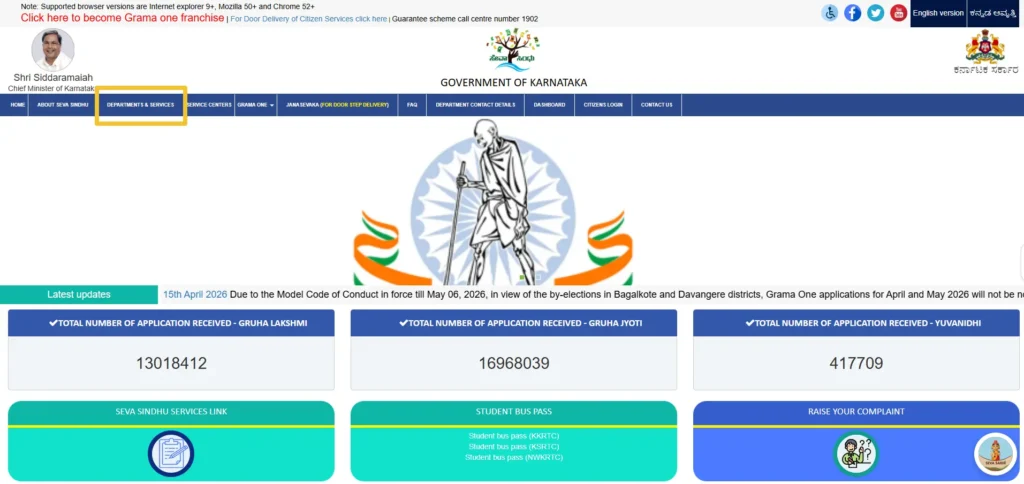
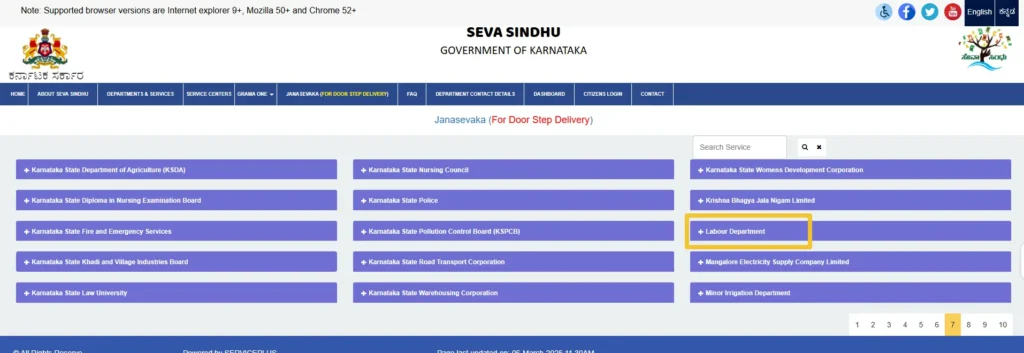
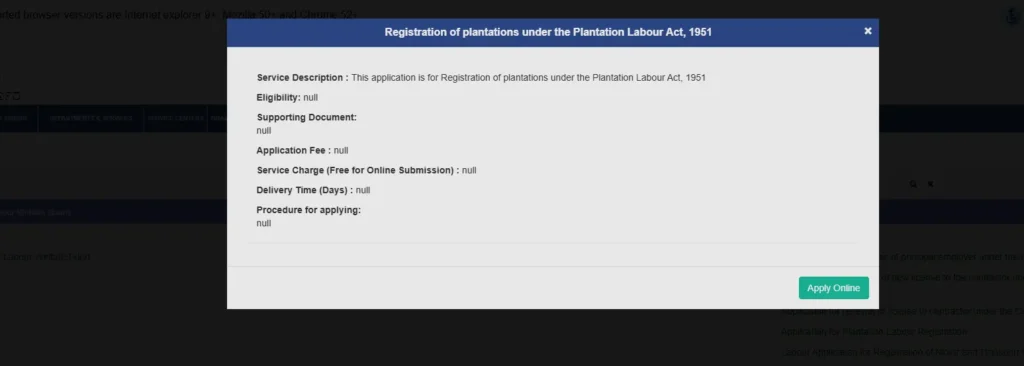
Karnataka has moved registration to the Seva Sindhu portal. Follow these steps:
Employees covered by the Karnataka Shops and Establishments Act are entitled to three types of leave:
Casual Leave: 12 days per year (short-notice personal leave).
Sick Leave: 12 days per year (illness/medical reasons).
Earned Leave (Privilege Leave): 1 day for every 20 days worked.
If an employee leaves with unused earned leave, you must encash it. Failing to do so is a violation.
Wages, Pay Day Rules, and Employment Terms
The Act regulates when and how wages are paid, as well as what wage deductions are allowed.
Pay Day Rules
Establishments with fewer than 1,000 employees must pay wages by the 7th of the following month.
Establishments with 1,000 or more employees must pay wages by the 10th of the following month.
In Karnataka, salary deductions also include statutory components like PT. You can review applicable slabs using the Karnataka PT calculator.
Deductions from Wages
You can only make deductions permitted under the Payment of Wages Act, 1936 (such as PF, ESI, PT, authorized loans, and advances).
Notice Period and Termination
If you terminate an employee who has completed more than three months, you must provide one month’s notice or wages in lieu of notice.
Maternity Benefits
You must comply with the Maternity Benefit Act, 1961 alongside the S&E Act. Eligible female employees are entitled to 26 weeks of paid maternity leave for the first two children.
Health, Safety, and Welfare Obligations
Inspectors verify these standards during visits. Your minimum obligations are:
Keep premises clean and hygienic at all times
Ensure adequate lighting in all work areas
Provide proper ventilation (natural or mechanical)
Supply clean drinking water for all employees
Maintain adequate sanitation and toilet facilities
Provide an accessible first-aid box
For establishments with a large number of female employees, separate sanitation facilities are required. The POSH Act, 2013 also requires an Internal Complaints Committee for businesses with 10 or more employees.
Penalties for Non-Compliance
Non-compliance can trigger financial penalties from day one of violation, with possible prosecution for repeated defaults.
First offense: Fine up to ₹5,000 for most violations (overtime, leave records, etc.).
Subsequent offenses: Higher fines and possible prosecution of the employer.
Non-registration: Penalties begin from the mandatory registration date.
Serious violations: Child employment, false records, or safety lapses can attract heavier penalties and possible shutdown action.
Pro Tip
Key Risk: Labour Inspectors Inspectors can enter your premises during working hours without prior notice and verify registers, wage records, and working hours on-site. Keep HR records audit-ready at all times.
How HR Software Bangalore Simplifies Compliance with the Karnataka S&E Act
Tracking attendance, overtime, leave, registers, and pay day compliance manually is difficult at scale. A single error can create a compliance gap.
HR Software Bangalore automates each of these requirements for Karnataka businesses:
Attendance and overtime: Captures clock-in/out, flags overtime, and auto-calculates overtime pay.
Leave management: Tracks casual/sick/earned leave, accruals, balances, and exit encashment.
Wage registers: Generates Act-compliant registers for inspections on demand.
Payday compliance: Payroll reminders help you avoid missing the 7th/10th wage deadlines.
For Bangalore businesses managing 50 to 500 employees, manual processes quickly become a hidden compliance risk. Schedule a demo to see how HR Software Bangalore handles Karnataka S&E Act compliance for your team size.
FAQs
All shops and commercial establishments operating in Karnataka must register under the Act within 30 days of starting business. This includes offices, retail stores, startups, and service-based businesses, regardless of size or employee count.
The Act allows employees to work up to 9 hours per day and 48 hours per week. Employers must provide a break after 5 continuous hours and ensure one mandatory weekly off day.
Any work beyond the prescribed daily or weekly limits qualifies as overtime. Employers must pay overtime wages at twice the ordinary rate of pay.
Employees are entitled to 12 days of casual leave, 12 days of sick leave, and earned leave based on days worked. Unused earned leave must be encashed when the employee exits.
Employers must pay salaries by the 7th of the following month if they have fewer than 1,000 employees, and by the 10th if they have 1,000 or more employees.
Failure to comply can lead to fines up to ₹5,000 for first-time violations. Repeated non-compliance may result in higher penalties, legal action, and prosecution.
Missing an ESI registration deadline in Karnataka attracts a penalty of up to ₹5,000 per day of default and full back payment of contributions with interest. For a Bangalore business that crossed the 10-employee threshold three months ago without registering, that liability adds up fast.
This guide covers everything you need to know to register correctly and stay compliant with eligibility rules, the current contribution rates, the step-by-step online process, and what happens after registration.
What Is Employee State Insurance (ESI)?
ESI stands for Employee State Insurance. It is a social security and health insurance scheme managed by the Employees’ State Insurance Corporation (ESIC), an autonomous body under the Ministry of Labour and Employment.
The scheme requires employers and employees to make monthly contributions to a shared fund. In return, covered employees and their families receive medical care, cash benefits during sickness, maternity leave payments, disability compensation, and more.
Which Karnataka Businesses Must Register for ESI?
ESI eligibility works at two levels: the establishment level and the employee level. Both must be met for the obligation to apply.
Establishment-level threshold in Karnataka
Your establishment must have 10 or more employees. This count includes direct employees, contract workers, casual staff, and temporary workers. This also includes all workers regardless of whether their wages are above or below the ₹21,000 ceiling. If your business falls into any of these categories, registration is mandatory:
Factories and manufacturing units
Shops and retail establishments
IT and software companies (covered under Shops and Establishments)
Restaurants and hotels engaged in sales
Private educational institutions
Private medical institutions and hospitals
Cinemas and preview theatres
Road motor transport establishments
Newspaper establishments
NBFCs, insurance businesses, port trusts, and airport authorities
Warehousing establishments
Employee-level eligibility
Only employees whose gross wages are ₹21,000 per month or less are covered under the ESI scheme. For employees with a disability, the limit is ₹25,000 per month.
Employee Gross Wages
Coverage Status
Up to ₹21,000/month
Covered, ESI contributions apply
₹21,001 to ₹25,000/month (disability)
Covered, ESI contributions apply
Above ₹21,000/month (no disability)
Not covered, no ESI deductions
ESI Contribution Rates in Karnataka (2026)
The current ESI contribution rates apply uniformly across India, including Karnataka. Both employer and employee contribute a percentage of the employee’s gross wages every month.
Contributor
Rate
Calculated On
Employer
3.25%
Gross wages of covered employees
Employee
0.75%
Gross wages of the individual employee
Total
4.00%
Combined contribution per eligible employee
Worked Payroll Example for a Bengaluru Employee
Here is what ESI contributions look like for a Bengaluru-based employee on a ₹18,000 gross monthly salary:
Calculation
Amount
Employee gross wages
₹18,000/month
Employer ESI (3.25%)
₹18,000 × 3.25% = ₹585/month
Employee ESI (0.75%)
₹18,000 × 0.75% = ₹135/month
Total ESI contribution
₹720/month
The employer deducts ₹135 from the employee’s salary and adds their own ₹585 contribution. The total ₹720 must be remitted to ESIC by the 15th of the following month.
For a team of 20 employees all earning ₹18,000, your total monthly ESI remittance is ₹14,400 (20 × ₹720). Missing the 15th deadline attracts 12% interest per annum on the outstanding amount.
Documents Required for ESI Registration in Karnataka
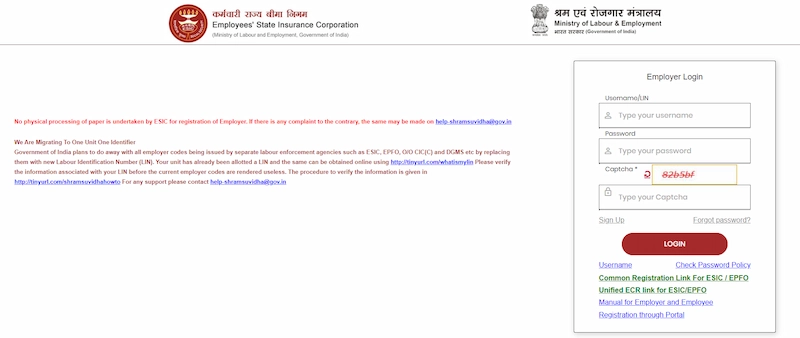
The ESIC registration process is fully online, with no physical documents required. All necessary information and documents are uploaded directly through the portal.
For companies and LLPs:
Certificate of Incorporation
Memorandum of Association and Articles of Association (for companies) or LLP Agreement (for LLPs)
Company or LLP PAN card
Address proof of the establishment: utility bill (electricity, gas, or telephone not older than 3 months), registered rent agreement, or property tax receipt
Canceled cheque of the company’s bank account
List of all employees with Aadhaar, photograph, bank account details, and date of birth
PAN card of all employees
Digital Signature Certificate (DSC) of the authorized signatory, or Aadhaar-based e-signature
For proprietorships and partnerships:
Partnership deed or business registration certificate (where applicable)
Proprietor or firm PAN card
Address proof of the establishment (same options as above)
Canceled cheque of the business bank account
Employee list with Aadhaar, photograph, bank account details, and date of birth
DSC of the proprietor or authorized partner
Tip for Bangalore IT companies: If your establishment is registered under the Karnataka Shops and Commercial Establishments Act, your S&E registration certificate serves as proof of establishment for the ESIC application.
How to Complete ESI Registration Online in Karnataka: Step-by-Step
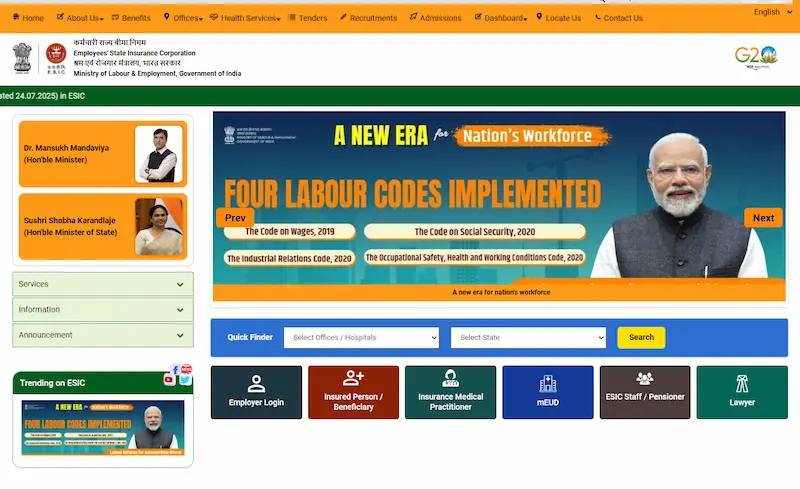
The entire process runs through the ESIC portal on their official website. There is no offline alternative. Here is a step-by-step process:
Step 1: Create an employer account on the ESIC portal
Go to esic.gov.in.
Click “Employer Login” on the home screen.
On the login page, click “Sign Up.”
Enter your company name, PAN, mobile number, and email address.
Submit the form.
You will receive a confirmation email and SMS with your login credentials.
Step 2: Log in and initiate new employer registration
Log in using the credentials received in your email.
On the dashboard, click “New Employer Registration.”
Step 3: Select your establishment type
Select the type of unit from the dropdown: Factory, Shop, or Other Establishment. For Bangalore IT companies and offices, select “Shop” or the establishment type that matches your Karnataka Shops and Establishments registration.
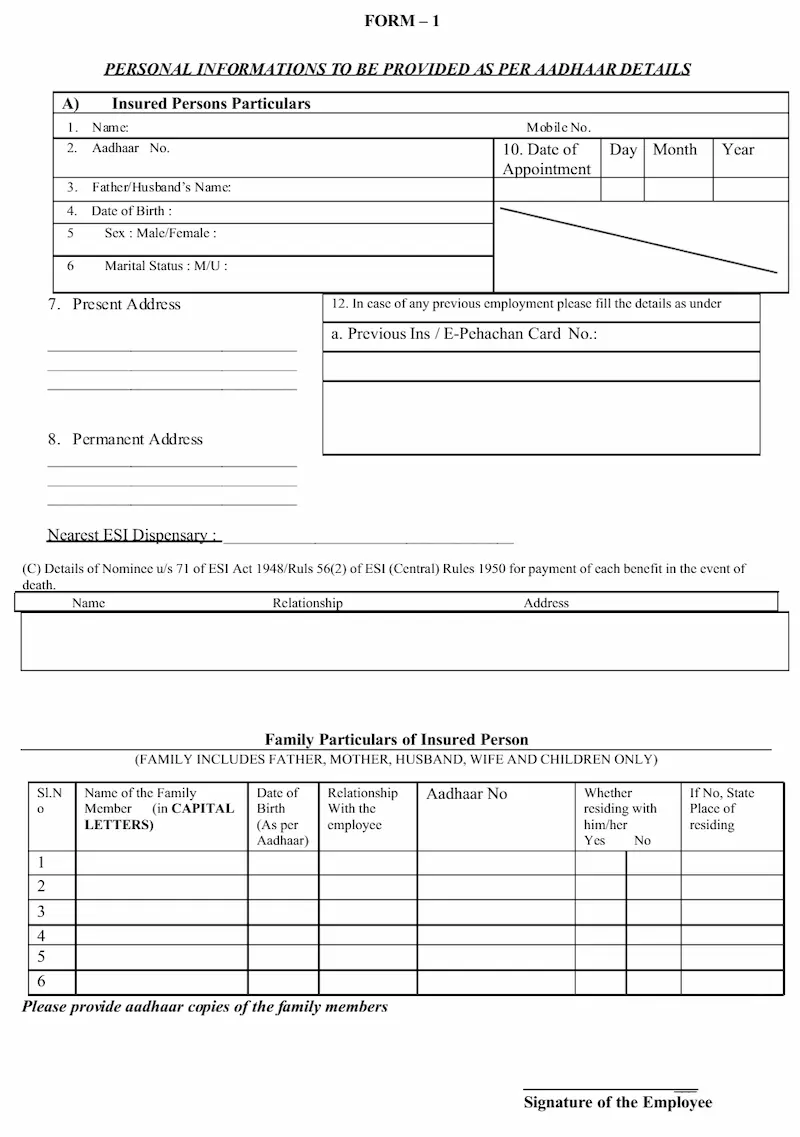
Step 4: Fill Employer Registration Form-1
Complete Form-1 with your establishment details: name, full address, nature of business, date of coverage (the date you first employed 10 or more employees), and total employee count.
Also, fill in the employer’s personal and contact details.
Step 5: Upload documents
Upload the establishment proof, address proof, PAN, and DSC of the authorized signatory.
Ensure all files are legible and within the portal’s file size limits.
Blurry or incomplete uploads are the most common reason for delays.
Step 6: Add employee details
Add each covered employee individually.
For each employee, enter their details, and the portal generates a unique 10-digit IP (Insurance Policy) number.
This IP number is the employee’s permanent ESI identity and is used for all future benefit claims.
Step 7: Pay the advance contribution and receive your Employer Code
After submitting the form, the portal will prompt you to pay an advance ESI contribution.
After successful payment, ESIC generates and emails the Registration Letter (C-11) to your registered email address.
This letter contains your 17-digit Employer Code Number, which is your proof of ESI registration.
ESI Benefits Your Employees Receive in Karnataka
Your employees gain access to the entire ESIC benefits network from day one of coverage. These are:
Benefit
What It Provides
Amount & Duration
Medical Benefit
Cashless treatment at ESIC hospitals, dispensaries, and empaneled private hospitals
From day one, for the employee and family
Sickness Benefit
Cash compensation during medically certified illness
70% of wages, up to 91 days/year
Extended Sickness Benefit
For specified long-term illnesses (e.g. TB, cancer, mental illness)
80% of wages, up to 2 years
Maternity Benefit
Paid leave for childbirth, miscarriage, or adoption
100% of wages, 26 weeks
Temporary Disablement
Cash during recovery from employment injury
90% of wages until recovery
Permanent Disablement
Monthly payment proportional to loss of earning capacity
90% of wages for life
Dependants’ Benefit
Monthly pension to the family if death occurs due to employment injury
90% of wages are distributed among dependants
Funeral Expenses
Lump sum for the death of an insured employee
₹15,000
Penalties for Non-Compliance with ESI in Karnataka
The penalties below apply uniformly in Karnataka and across India.
Default
Penalty
Delayed contribution payment
12% per annum simple interest on the outstanding amount for each day of delay
Non-registration
Up to ₹5,000 per day of default, plus recovery of all contributions with interest
Non-payment of contributions
Imprisonment of up to 3 years, with a minimum of 1 year
False statements or misrepresentations
Imprisonment up to 2 years, or fine up to ₹5,000, or both
Obstruction of ESIC inspection
Imprisonment up to 6 months, or fine up to ₹5,000
How HR Software Bangalore Simplifies ESI Compliance
Calculating ESI manually every month is where most errors happen. HR Software Bangalore built for Indian compliance handles both automatically. Here is what it does:
Auto-calculates 3.25% (employer) and 0.75% (employee) for every eligible employee based on their current gross wages each month
Automatically excludes employees whose salary has been revised above ₹21,000 from the next contribution cycle
Generates ESI contribution challans in the format required for ESIC portal submission, ready for the 15th of the month
Tracks each employee’s IP number and links it to their payroll record
Prepares half-yearly return data by consolidating wage, attendance, and contribution records across the period
Alerts your HR team when new joiners need to be registered on the ESIC portal within the 10-day window
Ready to automate your ESI calculations and never miss a contribution deadline?
If your establishment employs 10 or more people and at least some earn ₹21,000 per month or less, you must register with the ESIC within 15 days of crossing that threshold. This follows the standard central government threshold under Section 1(5) of the ESI Act.
The employer contribution rate is 3.25% of the covered employee’s gross wages per month. The employee contribution is 0.75% of their gross wages. The total combined contribution is 4% of gross wages per covered employee.
Go to esic.gov.in, create an Employer account, fill Form-1, upload documents, add employee details, pay the initial contribution, and receive the C-11 Registration Letter with a 17-digit Employer Code, usually within 5–7 working days.
The ESI scheme covers employees earning up to ₹21,000 gross wages per month. For employees with a disability, the ceiling is ₹25,000 per month. Employees earning above ₹21,000 are not covered, and no ESI deductions apply to them.
No. Employees meeting the wage eligibility criteria cannot opt out of ESI. Coverage is mandatory for all employees earning ₹21,000 or less per month in a covered establishment. Employers similarly cannot opt employees out.
Professional Tax is a state-level deduction that every employer in Karnataka must calculate, deduct from employee salaries, and remit to the government every month. Get the slab wrong, miss a due date, or fail to register, and the liability falls entirely on the employer.
This guide covers the Karnataka Professional Tax slab rates for 2025-26, who must pay, how to calculate the deduction, filing deadlines, and how to avoid the most common compliance errors.
What Is Professional Tax in Karnataka?
Professional Tax is a tax levied by the Karnataka state government under the Karnataka Tax on Professions, Trades, Callings and Employments Act 1976. It applies to all individuals earning a salary or income from a profession, trade, or employment within the state.
For salaried employees, the employer deducts PT from the employee’s monthly gross salary and remits it to the Karnataka Commercial Taxes Department. The employer is also liable to pay their own PT as a business entity.
PT collected from employees is deposited under the employee’s name. It is deductible as an expense under Section 16(iii) of the Income Tax Act, reducing the employee’s taxable income for the year.
Karnataka PT Slab Rates for 2025-26
The following are the monthly PT slab rates applicable in Karnataka for the financial year 2025-26.
Monthly Gross Salary
Monthly PT Deduction
Up to Rs. 15,000
Nil
Rs. 15,001 to Rs. 25,000
Rs. 150 per month
Rs. 25,001 and above
Rs. 200 per month (Rs. 300 in February)
The February special rate brings the annual total to Rs. 2,500 per employee, which is the maximum PT payable under Karnataka law.
April to January (10 months): Rs. 200 x 10 = Rs. 2,000
February: Rs. 300
March: Rs. 200
Total annual PT deduction: Rs. 2,500
Maximum PT per year under Karnataka law: Rs. 2,500
Who Must Pay Professional Tax in Karnataka?
Professional Tax applies to two categories of people in Karnataka.
Employees: All salaried individuals earning above Rs. 15,000 gross per month, employed with any organisation registered or operating in Karnataka.
Employers (Enrolled Persons): Every business, firm, company, or organisation employing staff in Karnataka must also pay PT as an enrolled person. The annual PT for enrolled persons varies by the nature of the business and is a flat fee, separate from the employee deduction.
PT applies to all employment types including full-time employees, contract staff, consultants drawing a monthly retainer, and directors drawing a salary. It does not apply to employees earning below Rs. 15,000 gross per month.
How to Calculate Karnataka Professional Tax
Karnataka PT is calculated on the employee’s monthly gross salary, not the basic salary. Gross salary includes basic pay, HRA, all allowances, and any other taxable components.
Step-by-Step Calculation
Calculate the employee’s total gross salary for the month.
Check which PT slab the gross salary falls into (see table above).
Apply the slab rate: Rs. 150 if gross is Rs. 15,001 to Rs. 25,000. Rs. 200 if gross is above Rs. 25,000 (Rs. 300 in February).
Deduct the PT amount from the employee’s net salary.
Remit the collected PT to the Karnataka Commercial Taxes Department by the 20th of the following month.
Example Calculation
Employee A earns Rs. 42,000 gross per month. Monthly PT deduction is Rs. 200 (Rs. 300 in February). Total annual PT: Rs. 2,500.
Employee B earns Rs. 18,000 gross per month. Monthly PT deduction is Rs. 150. Total annual PT: Rs. 1,800.
Employee C earns Rs. 14,000 gross per month. PT deduction is Nil, as gross is below Rs. 15,000.
How to Register for Professional Tax in Karnataka
Every employer must obtain two registrations under the Karnataka PT Act.
Employer Registration Certificate (RC): Required for deducting PT from employee salaries and remitting it to the government. Apply at the Karnataka Commercial Taxes Department or through the online portal.
Enrollment Certificate (EC): Required for the employer’s own PT liability as a business entity. The annual fee depends on the category of the business.
New businesses in Karnataka must register within 30 days of commencing operations or engaging employees. Registration is done online at the Karnataka Commercial Taxes Department portal.
Non-payment or late payment of Professional Tax attracts the following consequences under the Karnataka PT Act.
Interest at 1.25% per month on the unpaid amount, calculated from the due date
Penalty up to 50% of the tax due for wilful non-payment
Prosecution for repeated or deliberate defaults
Recovery proceedings where the department can attach bank accounts or assets
For most employers, the financial risk is not the PT amount itself but the cumulative interest and penalties for multiple months of non-compliance. For a team of 100 employees paying Rs. 200 each, one missed month means Rs. 20,000 in arrears plus interest.
Common Professional Tax Mistakes Karnataka Employers Make
Calculating PT on basic salary instead of gross salary
Forgetting the Rs. 300 February deduction and deducting Rs. 200 instead
Not registering newly hired employees in the monthly PT workings
Missing the enrollment certificate renewal deadline
Not updating slabs when the state revises them
Using a generic payroll tool that does not include Karnataka PT logic
How HR Software Bangalore Handles Karnataka PT Automatically
HR Software Bangalore calculates Professional Tax for every Karnataka employee automatically each month. The system applies the correct slab based on gross salary, handles the February Rs. 300 adjustment without manual input, and generates the monthly PT challan ready for payment.
When you add a new employee, their PT calculation starts immediately based on the gross configured in the system. PT data feeds directly into payroll so the deduction appears correctly on every payslip. Learn more about our statutory compliance software for Bangalore businesses.
Frequently Asked Questions
Yes. Contract employees and consultants drawing a monthly retainer above Rs. 15,000 are subject to Karnataka PT. The hiring organisation is responsible for deducting and remitting PT if the contractor works under an employment-like arrangement. For genuinely independent contractors, PT liability rests with the individual.
Karnataka PT is not refundable in the usual sense. However, since PT is deductible under Section 16(iii) of the Income Tax Act, the employee recovers its value indirectly through a reduction in taxable income. Excess PT deducted due to employer error must be refunded by the employer to the employee.
No. Professional Tax is state-specific. Each state that levies PT sets its own slabs, rates, and due dates. Karnataka PT differs from Maharashtra PT, Andhra Pradesh PT, Tamil Nadu PT, and others. Not all states levy professional tax.
Yes. Directors drawing a salary or remuneration from a company registered in Karnataka are subject to PT on their monthly income. The company must deduct and remit PT on behalf of such directors just as it does for regular employees.
The Registration Certificate (RC) is for employers to deduct PT from employees and remit it. The Enrollment Certificate (EC) is for the employer’s own PT liability as a business entity. Every employer in Karnataka needs both. The EC is a one-time registration with periodic renewal.
Ready to Automate Karnataka PT Compliance?
Use the Karnataka PT Calculator to check exact deductions for your team, or book a demo to see how HR Software Bangalore handles PT compliance automatically.