Running payroll manually is a compliance risk in 2026, not just a time problem. The New Labour Codes have introduced a 50% minimum basic pay rule, a 48-hour full and final settlement requirement, and mandatory digital record formats. Any payroll process that cannot keep up with these changes exposes your business to inspection notices and penalties.
This guide compares the 12 best payroll software tools available in India in 2026, with features, pricing in INR, and a clear view of which tool suits your company size and compliance requirements.
What Is Payroll Software and Why Does It Matter in 2026?
Payroll software is a digital tool that automates salary calculations, statutory deductions, payslip generation, and compliance filings. It combines attendance, leave, and employee data into a single processing run, so your payroll team does not have to reconcile spreadsheets at month-end.
The four New Labour Codes are in force. In 2026, it matters more than ever because it ensures compliance with the New Labour Codes, streamlines PF/ESI/Gratuity calculations, supports the 50% wage rule, enables 48-hour full and final settlements, and maintains mandatory digital records for audits.
What to Look for in Indian Payroll Software
Use these six criteria to evaluate any payroll tool before booking a demo.
New Labour Code compliance readiness: Verify if the tool’s salary structure engine enforces the 50% basic pay rule. Ensure full and final settlements can be processed independently of the monthly payroll cycle.
Multi-state statutory support: India has 29 state-level Professional Tax regimes, varying LWF contribution schedules, and state-specific Minimum Wage notifications. Your payroll software must handle the states where your employees are located without manual rate entry.
Payroll and HRMS integration: A tool that integrates with attendance, leave, and employee records eliminates the manual data transfer that causes most payroll errors. The stronger the integration, the lower the error rate.
F&F settlement automation: The 48-hour F&F rule makes the old practice of processing settlements in the next monthly cycle non-compliant. Your tool must support F&F calculations that work independently of the regular payroll run.
Employee self-service: An ESS portal that lets employees download payslips, submit investment declarations, and view Form 16 reduces the volume of routine HR queries.
12 Best Payroll Software in India (2026)
1. HR Software Bangalore
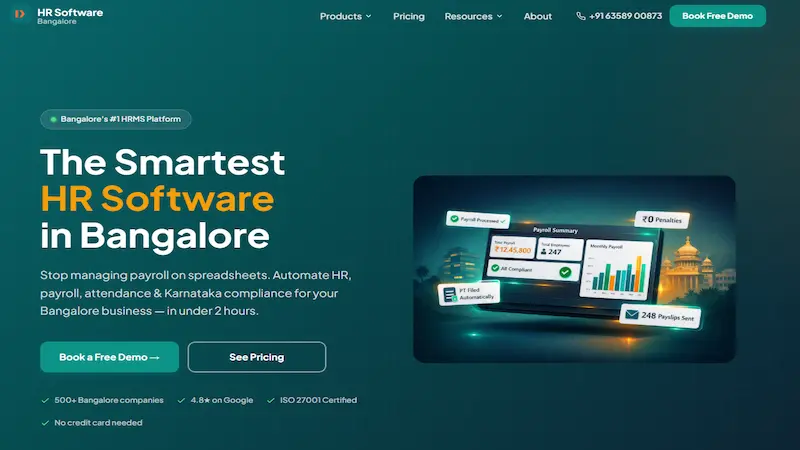
HR Software Bangalore is an automated HR and payroll platform for Indian businesses. Compliance features like Professional Tax slabs, ESI contributions, PF at 12% of basic, and LWF deductions in June and December are handled automatically.
The payroll module connects directly with attendance, leave, and employee records. The platform supports the 50% wage rule under the New Labour Codes and includes the F&F settlement workflow to meet the 48-hour requirement.
Key features:
50% basic pay compliance
Automated Karnataka PT deductions
PF, ESI, LWF automated
On-demand F&F processing
Employee self-service portal
Digital statutory records
Pricing: Custom pricing based on company size.
Best for: Small, medium, and large businesses that need payroll with local compliance support.
2. greytHR
greytHR is India’s most established cloud payroll platform. Founded in 2009 and trusted by over 20,000 businesses, it is the default starting point for many Indian HR teams moving off spreadsheets. Its strength is compliance accuracy and audit-ready reporting.
Key features:
Automated salary calculations
Full PF, ESI, PT, LWF, TDS
Scheduled paysheet builder
Form 16, 24Q, challan generation
Mobile ESS for payslips and leave
End-to-end payroll workflows
Pricing: Starts around ₹3,495 per month for up to 50 employees.
Best for: Small and mid-size Indian businesses that want a reliable, established payroll platform with compliance.
3. Keka HR
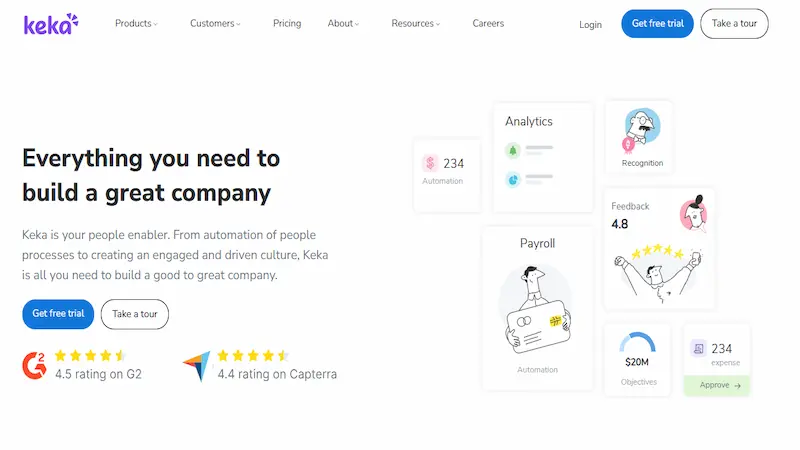
Keka is a modern India-first HRMS widely adopted by tech companies. Its payroll module is connected to attendance and leave data, so salary processing uses real-time inputs rather than manually imported figures. This integration is particularly useful for companies with complex shift patterns or variable attendance.
Key features:
Salary builder with TDS & CTC
Geo-fenced, selfie-based attendance
Integrated reimbursement management
Automated F&F settlement module
Payroll analytics & audit logs
ESS portal for payslips & leave
Pricing: Custom pricing based on company size.
Best for: Mid-size and large companies needing an integrated HRMS with proper attendance management.
4. factoHR
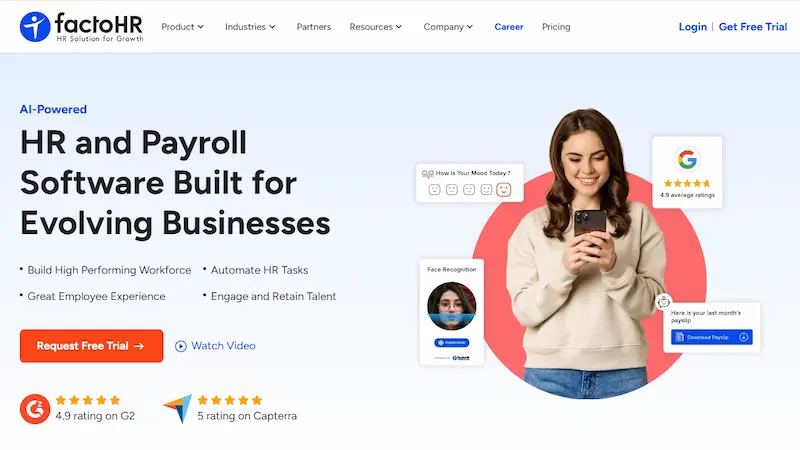
factoHR is an all-in-one hire-to-retire HRMS with a payroll engine built for Indian statutory requirements. It is widely used by SMBs and mid-market companies across India and covers the full payroll lifecycle from salary structure setup through to F&F settlement.
Key features:
Flexible salary structure builder
Auto PF, ESI, PT, TDS, LWF
Pay group configuration by category
Performance-linked payroll integration
On-demand F&F settlement module
Form 16, 24Q, challan generation
Pricing: Starts at ₹4,999 per month for up to 50 employees. ₹69 per employee per month for additional employees.
Best for: Indian SMBs and mid-size companies needing complete payroll and statutory compliance on a single platform.
5. Zoho Payroll
Zoho Payroll is the payroll module within the Zoho business ecosystem. For companies already using Zoho Books for accounting or Zoho People for HR, it delivers a connected payroll workflow without the need for a separate integration. Salary data flows into accounting automatically, and HR records stay in sync.
Key features:
Auto TDS, Form 16, email payslips
Employee tax declaration portal
Integration with Zoho apps
Custom salary and allowance templates
State-wise PT and LWF handling
ESS portal for payslips & IT
Pricing: Starts at ₹1,000 per organization per month, billed annually for 25 employees.
Best for: Small to mid-size businesses and growing enterprises that need a comprehensive payroll management system.
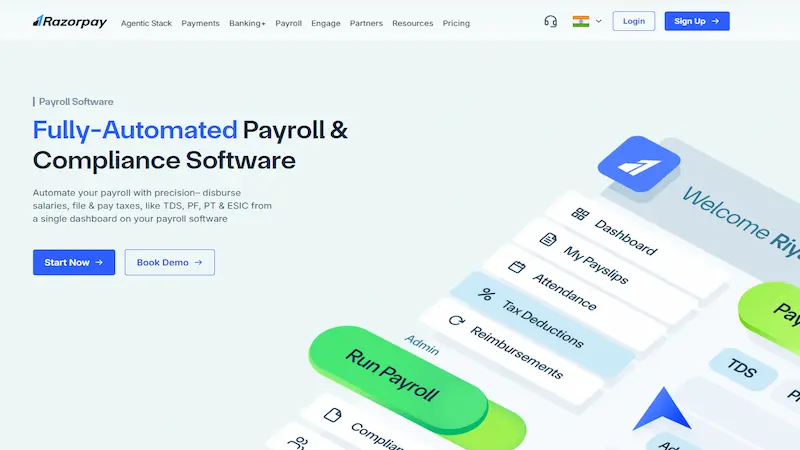
6. RazorpayX Payroll
RazorpayX Payroll is built by Razorpay and targets Indian startups and tech-first companies. Its differentiator is direct banking integration. Salaries are disbursed through Razorpay’s banking infrastructure, so there is no need to generate a separate bank file. Compliance filings are automated alongside payments.
Key features:
One-click salary disbursement via Razorpay
Auto PF, ESI, PT, LWF, and TDS filing
Contractor and freelancer payment support
Group health insurance integration
25+ accounting, biometric, and attendance integrations
Employee self-service portal for payslips and taxes
Pricing: Custom pricing based on company size.
Best for: Startups and digital-first companies that want fast payroll setup and automated compliance.
Ready to automate payroll and compliance for your Bangalore team?
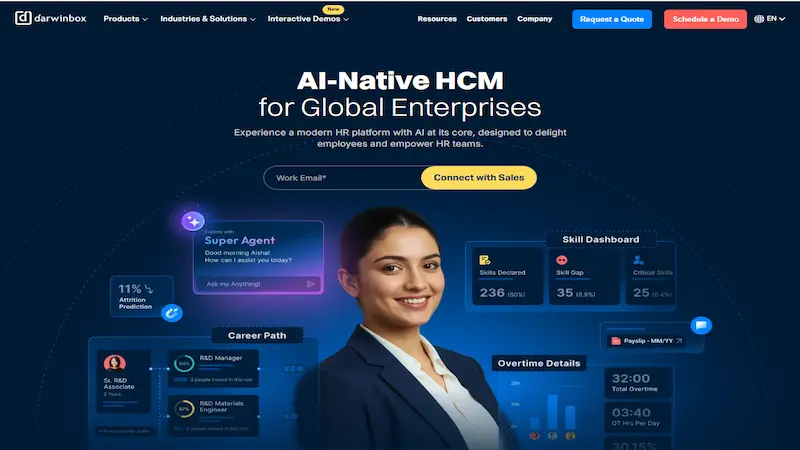
Darwinbox is an enterprise HCM platform built in India and used by large Bangalore organizations, fast-growing companies, and MNCs. Its payroll module is part of an integrated hire-to-retire suite that handles multi-entity and multi-state payroll at scale.
Key features:
Multi-entity, multi-state payroll
Full PF, ESI, PT, LWF, TDS compliance
AI anomaly detection before payroll
Integrated recruitment, performance, and leave data
Advanced payroll analytics and reports
Mobile-first for HR and employees
Pricing: On request, pricing is typically suited for large companies.
Best for: Large enterprises and Indian MNCs that need a full payroll and multi-state compliance at scale.
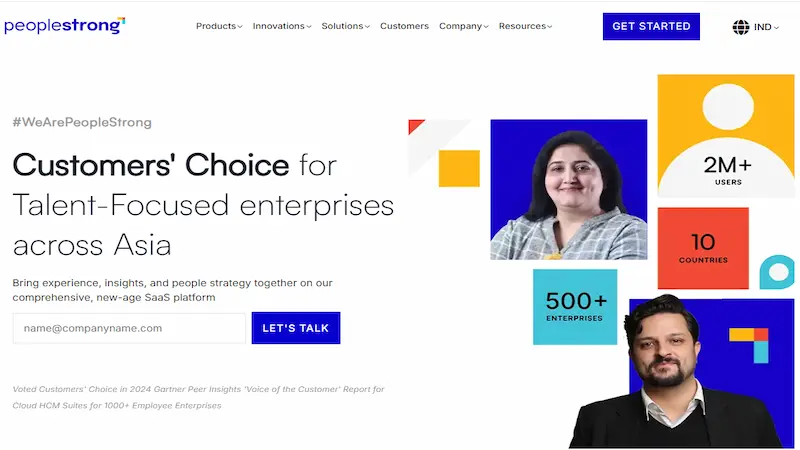
8. PeopleStrong
PeopleStrong is an enterprise payroll and workforce management platform with AI-driven zero-touch payroll processing. It is used by large enterprises across India and AsiaPac and processes over six million paychecks annually. Its strength is automation at scale combined with full audit readiness.
Key features:
Zero-touch payroll: pro-rata, variable pay, F&F
Multi-state compliance: PF, PT, ESI, LWF, TDS
Custom approval workflows with logs
AI chatbot for employee payroll queries
Workforce analytics: costs, headcount, attrition
Mobile ESS: payslips, Form 16, reimbursements
Pricing: Custom pricing based on company size.
Best for: Large enterprises and conglomerates needing AI-driven payroll automation and workforce analytics.
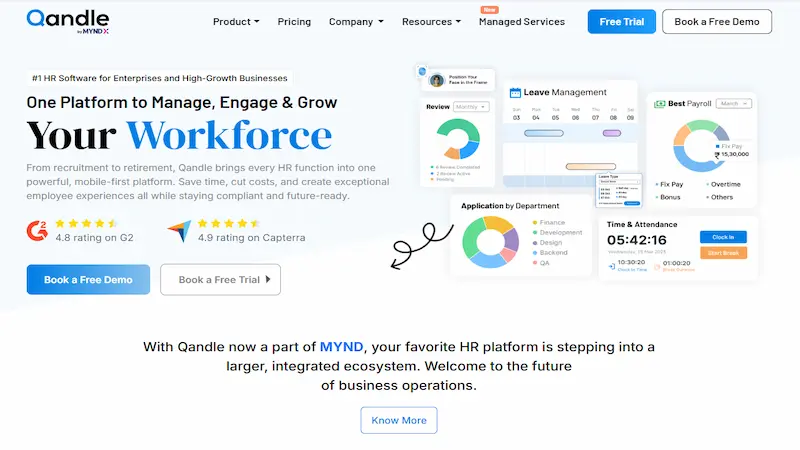
9. Qandle
Qandle is a modular HRMS with a flexible payroll engine that lets growing businesses configure their own salary structures rather than fitting into rigid templates. It suits companies that are expanding and need a payroll setup that adapts to new employee categories and locations without a complete system rebuild.
Key features:
Drag-and-drop salary structure builder
Auto-calculation: PF, ESI, PT, LWF, TDS
Off-cycle payroll for corrections/bonuses
F&F settlement with automatic dues
Form 16 & 12BA generation
Integration with attendance, leave, and performance
Pricing: The “Foundation” plan costs ₹2,450 per month for up to 50 employees, with ₹49 per month for each additional employee.
Best for: Growing businesses that need flexible payroll configuration and want to expand HR modules as headcount increases.
10. ZingHR
ZingHR is an AI-powered HCM platform with a mobile-first design and a payroll module that pulls attendance data from AI facial recognition and geo-fencing directly into salary calculations. This makes it a strong fit for companies with large field workforces or manufacturing operations where attendance accuracy directly drives payroll accuracy.
Key features:
Attendance-linked payroll with AI and geo-fencing
Full PF, ESI, PT, LWF, TDS compliance
AI chatbot for HR/payroll queries
Mobile ESS: payslips, tax, leave, claims
Analytics dashboard for payroll & productivity
Modular recruitment, engagement, and survey tools
Pricing: Custom pricing based on company size.
Best for: Mid-to-large enterprises that need a comprehensive, integrated HCM platform covering payroll and compliance.
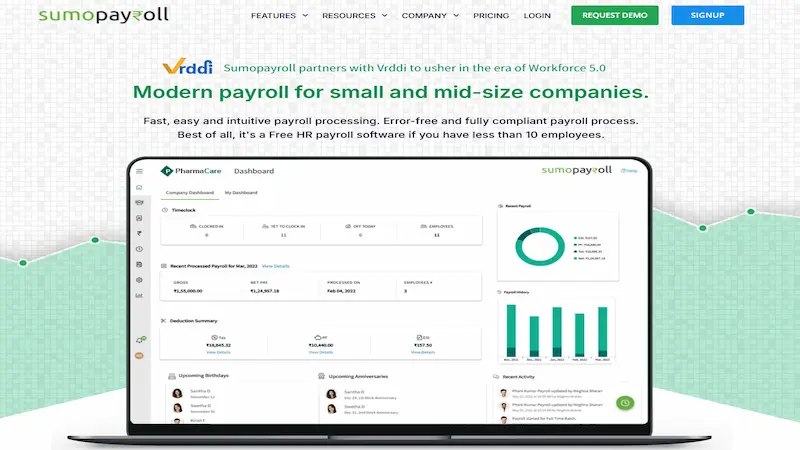
11. SumoPayroll
SumoPayroll is a lightweight cloud payroll tool built for Indian SMEs that need accurate statutory compliance without the cost or complexity of a full HRMS suite. It covers the core payroll requirements that most small businesses need and is designed to get teams up and running quickly.
Key features:
Automated TDS, PF, ESI, PT
Form 16 & 24Q generation
ESS portal for payslips & IT
Contractor & freelancer payments
Cloud-based mobile access
Reimbursement & advance integration
Pricing: SumoPayroll’s pricing starts at around ₹35 per employee per month.
Best for: Small businesses and startups that need accurate payroll automation and statutory compliance.
12. Deel
Deel is a global payroll and contractor management platform covering over 150 countries. It is the right choice when Indian companies employ people internationally or when international companies want to hire Indian employees in compliance without setting up a local entity.
Key features:
Multi-country payroll with Indian compliance
Unified payments for contractors and employees
Pre-vetted contracts for India and abroad
One-click global salary disbursement
Employer of Record for new countries
Compliance monitoring across jurisdictions
Pricing: Its global payroll services start at about $29 per employee per month.
Best for: Indian businesses with global teams, or international companies that need a single platform for multi-country payroll and compliance.
Quick Comparison: 12 Best Payroll Software in India
Tool
Best For
Starting Price
Labour Code Ready
HR Software Bangalore
Businesses needing payroll with compliance
Custom pricing based on company size
Yes
factoHR
SMBs and mid-size companies needing payroll & compliance
Rs.4,999/month (50 employees), Rs.69 per employee/month extra
Yes
greytHR
Small and mid-size businesses want a reliable payroll
Rs.3,495/month (50 employees)
Partial
Keka HR
Mid-size and large companies with integrated HRMS
Custom pricing based on company size
Partial
Zoho Payroll
Small to mid-size businesses in the Zoho ecosystem
Rs.1,000/month (25 employees, billed annually)
Partial
RazorpayX Payroll
Startups and digital-first companies
Custom pricing based on company size
Partial
Darwinbox
Large enterprises needing multi-state payroll
On request
Yes
PeopleStrong
Large enterprises needing AI payroll and analytics
On request
Yes
Qandle
Growing businesses need flexible payroll
Rs.2,450/month (50 employees), Rs.49/month per additional employee
Most payroll tools on this list are designed for a generic Indian audience. They handle central statutory requirements well. But they struggle with Karnataka-specific rules.
The Karnataka PT slab structure differs from that of Maharashtra. LWF contributions are collected twice a year in June and December. The Karnataka Shops and Establishments Act sets specific working hour limits for commercial establishments.
HR Software Bangalore is built from the ground up for this baseline. Karnataka PT slabs are pre-configured, not added manually. LWF contribution schedules run automatically in June and December. The payroll engine has been built to meet the New Labour Code requirements, including the 50% wage rule and the 48-hour F&F mandate.
You also get payroll, attendance and leave, employee self-service, recruitment, and performance management in one platform.
Frequently Asked Questions
For businesses, HR Software Bangalore is the strongest option. It is the right choice if your business is based in Bangalore or Karnataka and you want local compliance handled without manual configuration.
Some tools support it, some don’t. Check with the vendor if their system enforces 50% Basic + DA, flags non-compliant CTC, and updates PF automatically. Don’t assume it’s compliant.
Yes, HR Software Bangalore is well-suited for startups that need reliable payroll and compliance automation. It handles PF, ESI, PT, LWF, and F&F settlement and digital statutory records.
Payroll software automates PF, ESI, and Professional Tax by storing employee salary details and contribution rules. It calculates deductions, generates challans and statutory forms, and updates rates automatically when government rules change, so no manual adjustments are needed.
Your offer letter says Rs. 12 LPA. Your first payslip shows Rs. 78,000. That gap is not a mistake. CTC (Cost to Company) and in-hand salary are calculated very differently, and understanding the difference stops a lot of payroll confusion for both employees and HR teams.
This guide explains every component of a CTC structure, what gets deducted before the salary hits the bank account, and how Bangalore-specific deductions like Professional Tax affect the final take-home amount.
What Is CTC (Cost to Company)?
CTC is the total amount an employer spends on an employee in a year. It includes the employee’s direct salary, all allowances, employer-side statutory contributions, and benefits like insurance and gratuity provisioning.
⚠️ Important
CTC is not the amount credited to the employee’s bank account. It is an accounting figure that shows the full cost of employing that person. Several CTC components go directly to government accounts (like PF) or accrue over time (like gratuity) and are never paid as monthly cash.
What Is In-Hand or Take-Home Salary?
In-hand salary (also called take-home pay) is the amount actually credited to the employee’s bank account each month after all deductions. These deductions include employee PF contribution, ESI (if applicable), Professional Tax, and TDS on salary.
💡 Bangalore Benchmark
For most employees in Bangalore, in-hand salary falls between 65% and 75% of CTC. The exact percentage depends on the CTC structure, the employee’s tax regime, and applicable statutory deductions.
CTC Breakup: Every Component Explained
1. Basic Salary
Basic salary is the foundation of your CTC. It is typically 40% to 50% of total CTC. Basic salary is fully taxable and determines two important calculations: PF contribution (12% of basic) and gratuity eligibility.
For a Rs. 12 LPA CTC, basic salary is usually set between Rs. 4.8 LPA and Rs. 6 LPA, or Rs. 40,000 to Rs. 50,000 per month.
2. House Rent Allowance (HRA)
HRA is typically 40% to 50% of basic salary. Employees living in a rented house can claim HRA exemption under Section 10(13A) of the Income Tax Act. The exempt portion depends on actual rent paid, HRA received, and city. Bangalore qualifies as a metro city for HRA exemption purposes.
Employees not living in rented accommodation cannot claim the exemption and the full HRA amount becomes taxable.
3. Special Allowance
Special allowance is the balancing component in most salary structures. It fills the gap between basic plus HRA and the total gross salary. It is fully taxable with no exemption. Some employers split this into multiple named allowances (conveyance, transport, etc.) but the tax treatment is similar.
4. Performance Bonus / Variable Pay
Variable pay is a portion of CTC paid based on individual or company performance. It is typically 10% to 20% of CTC for most roles and higher for sales functions. Variable pay is usually paid quarterly or annually and is fully taxable in the year of receipt.
5. Employer PF Contribution (12% of Basic)
The employer contributes 12% of the employee’s basic salary to the Employees Provident Fund every month. This amount is part of CTC but is deposited directly into the EPFO account. The employee never sees this as cash.
Of the employer’s 12%, 8.33% goes to EPS (Employee Pension Scheme) subject to a maximum of Rs. 1,250 per month, and 3.67% goes to EPF.
6. Gratuity Provision
Gratuity is payable after 5 years of continuous service under the Payment of Gratuity Act. Employers include a monthly gratuity provision in CTC to account for this future liability. The standard formula used for CTC costing is: (Basic / 26) x 15 x (1/12) per month.
This provision is part of CTC but the employee only receives it at exit, after completing 5 years. It is not paid monthly.
7. Medical Insurance
Many employers include group health insurance as part of CTC. The premium paid by the employer is a CTC component but is not cash in hand. The value shown in the CTC letter is the annual premium allocated to that employee.
Monthly Deductions That Reduce In-Hand Salary
Deduction
Amount
Notes
Employee PF (12% of basic)
Rs. 4,800/month (on Rs. 40,000 basic)
Goes to EPFO account, not bank
Professional Tax (Karnataka)
Rs. 200/month (Rs. 300 in February)
Applicable to all employees earning above Rs. 15,000 gross
ESI (0.75% of gross)
Applicable if gross is below Rs. 21,000
Goes to ESIC; provides medical coverage
TDS on Salary
Varies by income and tax regime chosen
Deducted under Section 192; based on annual projection
CTC vs In-Hand Salary: A Practical Bangalore Example
This example shows how a Rs. 12 LPA CTC translates to an in-hand salary for a Bangalore employee under the old tax regime.
CTC Component
Annual (Rs.)
Monthly (Rs.)
Basic Salary (40% of CTC)
4,80,000
40,000
HRA (50% of basic)
2,40,000
20,000
Special Allowance
2,54,400
21,200
Performance Bonus
96,000
8,000
Employer PF (12% of basic)
57,600
4,800
Gratuity Provision
27,693
2,308
Medical Insurance Premium
18,000
1,500
Gross CTC
12,73,693
1,06,141
Less: Employee PF (12% of basic)
-57,600
-4,800
Less: Professional Tax (Karnataka)
-2,500
-200 (avg)
Less: TDS (estimated, old regime)
-50,000
-4,167
In-Hand / Take-Home Salary (approx)
8,62,900
71,908
In this example, a Rs. 12 LPA CTC results in approximately Rs. 71,908 per month in-hand. The effective take-home is about 67% of CTC. The actual figure will vary based on the tax regime chosen, actual rent paid, and investment declarations under Section 80C.
💡 How the Calculation Works
Step 1: CTC minus Employer PF and Gratuity = Gross Salary Step 2: Gross Salary minus Employee PF (12% of basic) = Taxable Salary Step 3: Taxable Salary minus PT (Karnataka) = Net before TDS Step 4: Net before TDS minus TDS (as per regime) = In-Hand Salary Result: In-hand is typically 65% to 75% of CTC for Bangalore employees
Calculate Your Exact In-Hand Salary from CTC
Use the free Bangalore Salary Calculator to see your take-home after PF, PT, and TDS deductions.
New Tax Regime vs Old Tax Regime: Impact on In-Hand Salary
The choice of tax regime significantly affects monthly TDS deductions and therefore the in-hand salary.
Under the new tax regime (default from FY 2023-24), lower tax rates apply but most exemptions and deductions (HRA, 80C, 80D) are not available. Under the old regime, higher rates apply but exemptions like HRA and Section 80C investments reduce taxable income.
For employees with significant HRA exemption (paying high rent in Bangalore) and active 80C investments, the old regime often results in lower TDS and higher take-home. For employees with minimal exemptions, the new regime is typically better.
HR Software Bangalore allows employees to declare their regime choice during investment declarations. The system adjusts monthly TDS deductions automatically based on the regime selected. Learn more about our payroll software for Bangalore businesses.
Frequently Asked Questions
CTC includes components that are never paid as cash: employer PF contribution (12% of basic), gratuity provisioning, and insurance premiums. On top of that, employee-side deductions (employee PF, PT, TDS) reduce your gross salary further. The gap between CTC and in-hand is typically 25% to 35%.
A higher basic salary increases PF contribution (both employee and employer sides), which builds retirement savings but reduces monthly take-home. It also increases gratuity payout over time. A lower basic with higher special allowance gives more monthly cash but lower long-term benefits.
HRA exemption in Bangalore (a metro city) is the least of three values: actual HRA received, 50% of basic salary, or actual rent paid minus 10% of basic salary. Only the exempt portion is tax-free. The rest is taxable. Employees must submit rent receipts or a rental agreement to claim this exemption.
For employees earning above Rs. 25,000 gross per month in Bangalore, the PT deduction is Rs. 200 per month (Rs. 300 in February). For those earning Rs. 15,001 to Rs. 25,000, it is Rs. 150 per month. Below Rs. 15,000, no PT is deducted.
Use this formula as a starting point: In-hand = CTC minus employer PF minus gratuity provision minus insurance, then minus employee PF, PT, and estimated TDS. For an accurate calculation specific to your CTC structure and tax situation, use the HR Software Bangalore Salary Calculator.
Know Exactly What Your Employees Take Home
HR Software Bangalore calculates CTC breakups, handles PT, PF, ESI, and TDS automatically, and generates accurate payslips every month.