Many Indian businesses buy an ERP thinking it covers HR, then spend months realising the HR module is too shallow for their actual payroll and compliance needs. Others invest in a standalone HRMS and wonder if they should have gone with an ERP instead.
This guide explains exactly what HRMS and ERP do, where they overlap, where they do not, and which one makes sense for your business right now.
Key Takeaways
- HRMS is built specifically for HR. ERP covers the entire business but does HR shallowly.
- Indian statutory compliance (PF, ESI, PT, TDS) works better in a dedicated HRMS.
- ERP implementation costs Rs. 5 lakh to 25 lakh and above for most Indian SMBs.
- Businesses with 20 to 500 employees almost always need HRMS first, not ERP.
- HRMS and ERP can work together through integration if your business grows to need both.
What is the Difference Between HRMS and ERP?
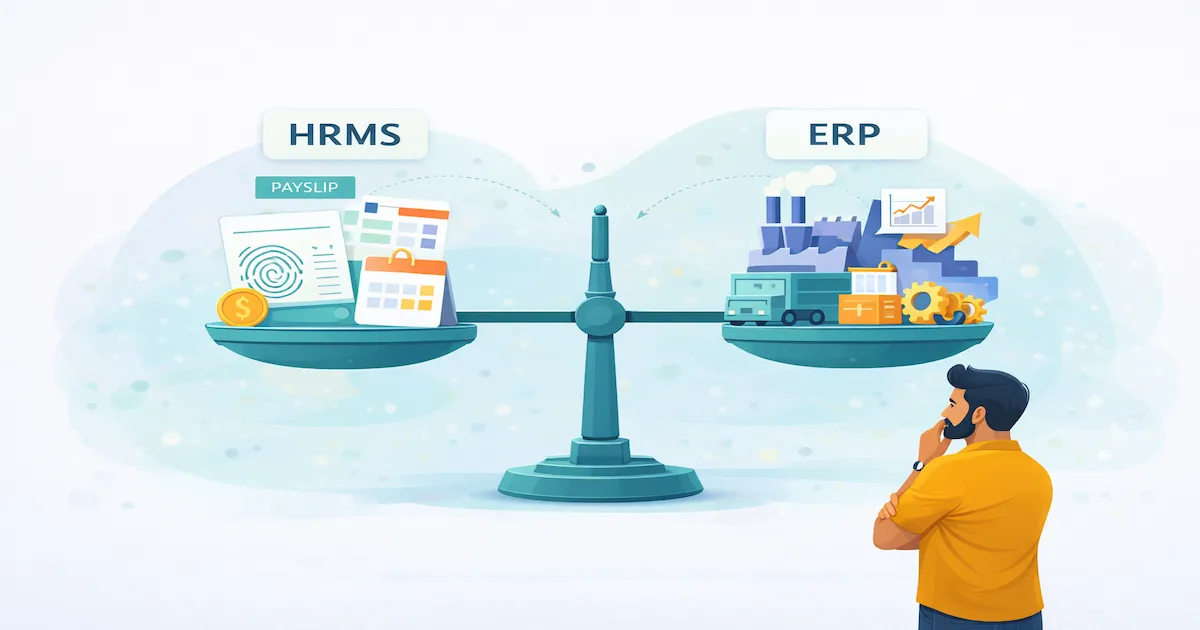
HRMS focuses entirely on HR. ERP connects every department in a business, including finance, supply chain, inventory, procurement, and HR, into one system. The difference is depth versus breadth.
An HRMS is purpose-built to manage every stage of an employee’s lifecycle. That means hiring, onboarding, attendance, payroll, compliance, appraisals, and exit. Every feature exists to serve the HR function.
An ERP is built to connect business operations across departments. Finance talks to procurement, procurement talks to inventory, and HR is one module among many. The HR module in an ERP handles the basics but is rarely deep enough to manage Indian statutory compliance without significant customisation.
What Does an ERP System Do for HR?
An ERP handles basic HR record management. It stores employee data, tracks headcount, and sometimes processes payroll at a surface level.
Most ERP HR modules can do:
- Employee master data and org charts
- Basic leave tracking
- Simple payroll calculations
- Integration with finance for salary disbursement
What most ERP HR modules cannot do without heavy customisation:
- Auto-calculate Indian statutory deductions like PF, ESI, Professional Tax, and LWF
- Handle state-specific compliance rules (Karnataka PT slabs, for example)
- Generate Form 16, PF ECR files, or ESI contribution statements
- Run 360-degree appraisals or OKR-based performance cycles
- Provide employee self-service for payslips, leave applications, and tax declarations
For an Indian business with 50 to 500 employees, these gaps are not minor. Payroll errors and compliance penalties are real costs.
What Are the Limitations of Managing HR Through an ERP?
The three biggest limitations for Indian businesses are cost, compliance depth, and implementation time.
Cost: ERP implementation for an Indian SMB typically runs Rs. 5 lakh to Rs. 25 lakh and above, depending on the vendor, number of modules, and customisation required. That does not include annual licence fees or the internal resource cost of managing the rollout.
A standalone HRMS costs Rs. 40 to Rs. 80 per employee per month on average. For a 100-person company, that is Rs. 4,000 to Rs. 8,000 per month with zero implementation cost and a setup time measured in weeks.
Compliance depth: Indian payroll compliance is specific and changes regularly. PF contribution limits, ESI applicability thresholds, state-wise Professional Tax slabs, Labour Welfare Fund deductions, and TDS under Section 192 all require precise, up-to-date calculation logic.
ERP vendors build for global markets. India-specific compliance is either not built in or available only as a paid localisation module that still needs periodic manual updates. A dedicated HRMS built for Indian businesses handles this automatically.
Implementation time: ERP projects in India run 6 to 18 months on average. During that period, your HR team is still running payroll manually or on spreadsheets. A focused HRMS is live in weeks.
HRMS vs ERP: A Side-by-Side Comparison
| Feature | HRMS | ERP (HR Module) |
|---|---|---|
| Primary focus | HR only | All business operations |
| Payroll depth | Full: salary, deductions, arrears, bank files | Basic: often limited to disbursement |
| India compliance (PF, ESI, PT, TDS) | Built-in and auto-updated | Requires customisation or add-on |
| Attendance and leave | Detailed with GPS, biometric, shifts | Basic tracking only |
| Performance management | OKRs, appraisals, 360 reviews | Minimal or absent |
| Employee self-service | Full ESS portal | Limited |
| Implementation time | 2 to 8 weeks | 6 to 18 months |
| Cost for 100-person Indian SMB | Rs. 4,000 to Rs. 8,000 per month | Rs. 5 lakh to Rs. 25 lakh upfront |
| Best for | SMBs and mid-market (20 to 1,000 employees) | Large enterprises with multi-department integration needs |
Which One Should an Indian Business Choose?
For most Indian businesses with 20 to 500 employees, start with HRMS. Here is a simple way to think about it.
Choose HRMS if:
- Your primary problem is payroll accuracy, attendance tracking, or statutory compliance
- You have 20 to 500 employees and a small HR team
- You need to be live quickly without a long implementation project
- Your budget is limited and you want predictable per-employee pricing
- You operate in India and need PF, ESI, PT, and TDS handled automatically
Choose ERP if:
- You are a large enterprise with 500 or more employees and complex operations across finance, supply chain, and manufacturing
- Your biggest problem is connecting departments, not HR operations specifically
- You have the budget and internal resource for a 12-plus month implementation
- HR is a secondary concern and basic headcount management is enough for now
💡 Honest Answer
If you are a 30-person startup in Koramangala or a 200-person IT company in Whitefield, an ERP is overkill and the HR module will not solve your payroll and compliance problems. A focused HRMS will.
Can You Use HRMS and ERP Together?
Yes, and many larger Indian companies do exactly that. The typical setup is a strong ERP handling finance, procurement, and operations, with a dedicated HRMS managing HR and payroll. The two systems share data through an API integration.
This gives you the depth of a purpose-built HRMS for HR functions and the breadth of an ERP for business operations. Payroll data flows from HRMS to ERP for financial reporting without manual exports.
If your business grows to this stage, most modern HRMS platforms support integration with popular ERP systems. You do not need to rebuild from scratch.
The Bottom Line
HRMS and ERP solve different problems. ERP connects your business. HRMS runs your HR.
For the vast majority of Indian SMBs, especially those dealing with monthly payroll, Karnataka statutory compliance, or growing headcount, an HRMS is the right first investment. It is faster to implement, built for Indian compliance, and a fraction of the cost.
Once your business reaches a scale where connecting finance, procurement, and HR in one platform makes sense, you can either upgrade to a full ERP or integrate your HRMS with an ERP alongside it.
If you are still managing payroll on spreadsheets or struggling with PT and PF filings, start with HR Software Bangalore. It is built specifically for businesses like yours, handles Karnataka compliance automatically, and takes under two hours to set up.
Frequently Asked Questions
HRMS can be a module within an ERP, but it is also available as a standalone product. The HR module inside most ERPs is much less detailed than a dedicated HRMS, especially for Indian statutory compliance requirements like PF, ESI, and Professional Tax.
Not effectively for most Indian SMBs. ERP HR modules typically do not handle India-specific compliance like state-wise Professional Tax, LWF deductions, or PF ECR file generation without expensive customisation. A standalone HRMS handles these out of the box.
HRMS is better for payroll, particularly in India. It includes built-in deduction logic for PF, ESI, PT, and TDS, generates payslips and Form 16, and creates bank transfer files. ERP payroll modules are designed for basic salary disbursement and require add-ons for Indian compliance.
Most small businesses with under 200 employees do not need a full ERP. The cost, implementation time, and complexity are not justified at that scale. A focused HRMS covers everything an SMB needs for HR and payroll at a much lower cost.
HRIS stores employee data and records. HRMS automates HR operations including payroll, attendance, and compliance. ERP integrates all business functions including HR, finance, and supply chain. For HR operations, HRMS is the most complete option among the three.
Ready to Eliminate Manual HR Work?
Join 500+ Bangalore businesses that have automated payroll, attendance, and Karnataka compliance with HR Software Bangalore.