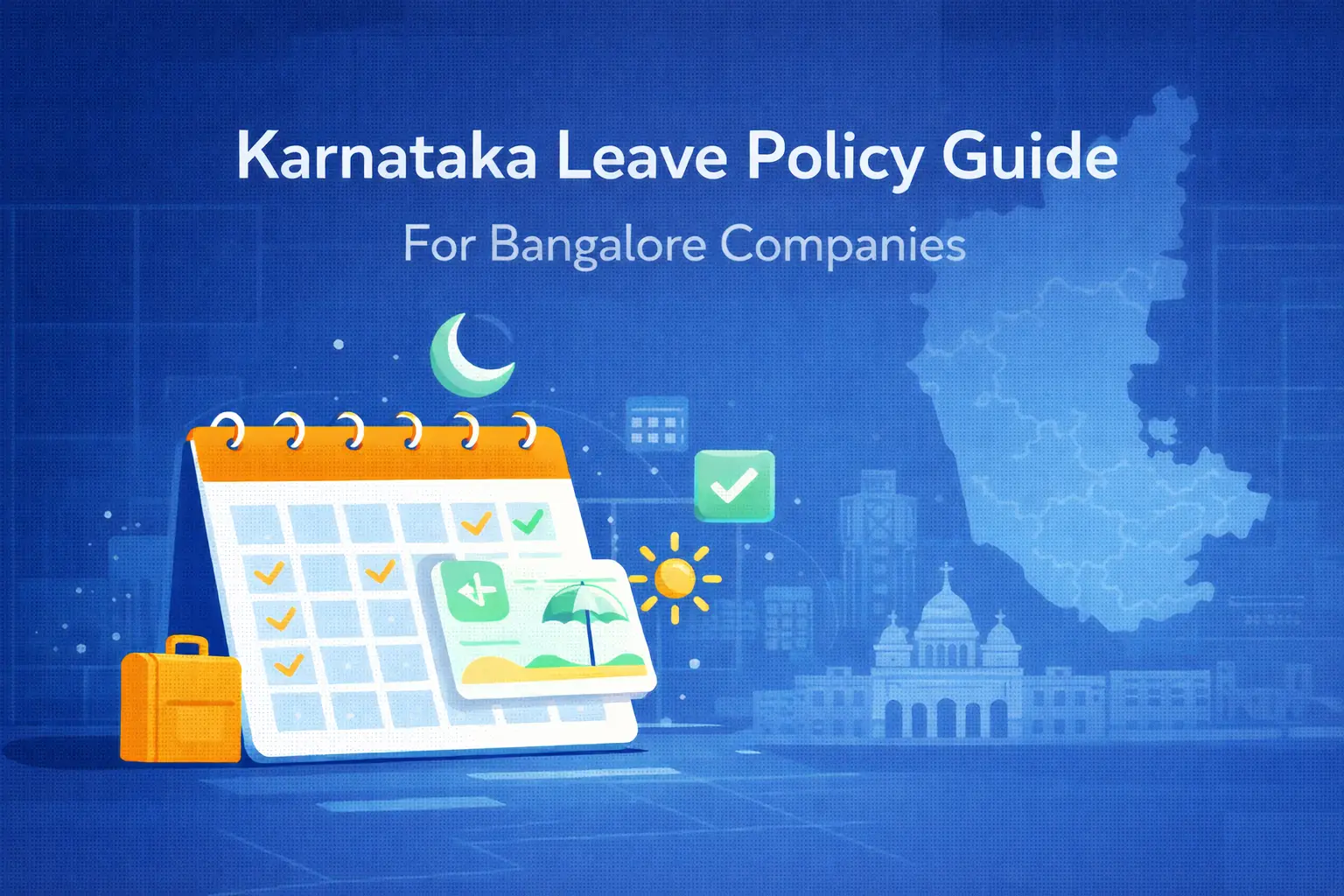
Most Bangalore companies have a leave policy. Far fewer have one that actually matches what Karnataka law requires. That gap is where employee disputes, labour complaints, and inspection penalties arise.
This guide covers every leave entitlement mandated by the Karnataka Shops and Commercial Establishments Act, explains the rules that catch employers off guard, and gives you a ready-to-use template you can adapt for your company today.
Key Takeaways
- Understand which laws govern leave for Bangalore companies: Karnataka S&E Act, Factories Act, and Maternity Benefit Act.
- Know the statutory leave entitlements: Earned Leave, Casual Leave, Sick Leave, Maternity Leave, and Public Holidays.
- Public holidays include 8–10 days per year, with three mandatory national holidays (Republic Day, Independence Day, and Gandhi Jayanti).
- Employers can offer optional leave benefits like paternity, bereavement, marriage, wellness days, optional holidays, and compensatory leave.
- Common compliance mistakes include not maintaining a leave register, denying earned leave, not encashing leave on exit, and mixing casual and sick leave without a written policy.
What Laws Govern Leave for Bangalore Companies?
Three laws cover leave for Bangalore employers, and which one applies depends on the nature of your business.
The Karnataka Shops and Commercial Establishments Act, 1961 is the primary law governing most businesses in Bangalore. It applies to offices, IT companies, retail establishments, restaurants, co-working spaces, BPOs, and startups.
The Karnataka Factories Act applies to manufacturing and industrial units. The leave entitlements differ slightly from those under the S&E Act and are covered in a separate section below.
The Maternity Benefit Act 1961 is a central law that applies to all establishments with 10 or more employees, regardless of state. It governs maternity leave and overrides any state-level provision on the same subject.
One important clarification: if your employees work from home but are based in Karnataka, they still fall under the Karnataka S&E Act. The Act applies based on employee location, not office location.
What Are the Statutory Leave Entitlements Under the Karnataka S&E Act?
The Karnataka Shops and Commercial Establishments Act mandates three types of leave. Your internal policy cannot offer less than these numbers.
Earned Leave (Privilege Leave)
Earned leave in Karnataka accrues at 1 day for every 20 days actually worked. An employee needs to work a minimum of 240 days in a year to earn the full entitlement of 12 days. Key rules employers frequently get wrong:
- Accrual timing: Earned leave starts accruing from the date of joining, not from the start of the calendar year. A new joiner in July earns leave based on the days worked from July onwards.
- Carry-forward cap: Unused earned leave can be carried forward to the next year, up to a maximum of 45 days.
- Encashment on exit: When an employee resigns, retires, or is terminated, you must encash all accumulated earned leave. Failing to pay this is a compliance violation.
Casual Leave and Sick Leave
The Karnataka S&E Act provides 12 days of combined casual and sick leave per year. The Act does not split this into a fixed number of casual days and sick days. That split is left to the employer’s policy. The rules that apply to both:
- No carry-forward: Casual and sick leave lapses at the end of the year if unused. It cannot be accumulated or encashed.
- Full pay: Both types are paid leave at the employee’s ordinary wage rate.
- Medical certificate: For sick leave beyond two consecutive days, it is standard practice to require a medical certificate.
Maternity Leave
Maternity leave in Bangalore is governed by the Maternity Benefit Act 1961, a central law that takes precedence over state rules. The entitlements are:
- 26 weeks of paid maternity leave for female employees for the first two children
- 12 weeks for the third child onwards
- 6 weeks in case of miscarriage or medical termination of pregnancy
- 12 weeks for adoptive mothers and commissioning mothers (surrogacy), calculated from the date the child is handed over
The employee must have worked for at least 80 days in the 12 months immediately preceding the expected date of delivery. If your establishment employs 50 or more employees, you must provide a creche facility, either within the premises or within a reasonable distance.
Public and National Holidays
Bangalore companies must observe a minimum of 8 to 10 public holidays per year. Three of these are mandatory national holidays that no employer can omit:
- Republic Day (26 January)
- Independence Day (15 August)
- Gandhi Jayanti (2 October)
You must declare your company holiday list at the start of each calendar year and communicate it to all employees. Changing the list mid-year without adequate notice creates a compliance issue.
Leave Entitlements at a Glance
| Leave Type | Entitlement | Carry-Forward | Encashable at Exit | Notes |
|---|---|---|---|---|
| Earned Leave | 12 days/year (1 per 20 days worked) | Up to 45 days | Yes | Min 240 working days to earn full entitlement |
| Casual Leave | As per policy (part of 12-day CL+SL pool) | No | No | Lapses if unused at year-end |
| Sick Leave | As per policy (part of 12-day CL+SL pool) | No | No | Medical certificate required for 2+ consecutive days |
| Maternity Leave | 26 weeks (first 2 children), 12 weeks (3rd+) | N/A | N/A | Governed by the Maternity Benefit Act 1961 |
| Public Holidays | 8–10 days/year | N/A | N/A | 3 mandatory national holidays + state notifications |
What Are the Leave Rules for Industrial Establishments in Bangalore?
If your business is a manufacturing or industrial unit, the Factories Act applies instead of the S&E Act.
| Leave Type | Entitlement | Carry-Forward |
|---|---|---|
| Earned Leave | 15 days/year (1 day per 20 days worked) | Up to 45 days |
| Casual Leave | 7 days/year | No carry-forward |
| Sick Leave | 7 days/year | No carry-forward |
| Paternity Leave | 15 days (mandatory for men with fewer than 2 surviving children) | N/A |
If you operate both a manufacturing unit and a corporate office in Bangalore, each set of employees is covered by its respective law.
What Optional Leave Benefits Do Bangalore Employers Commonly Offer?
Beyond statutory minimums, most Bangalore IT companies and startups offer additional leave benefits. These are not legal requirements under the S&E Act but have become standard practice in the job market.
- Paternity leave: Not mandatory under the S&E Act, but the industry standard is 5 to 15 days of paid paternity leave. Some larger IT companies offer up to 4 weeks.
- Bereavement leave: Not mandated by law, but 3 to 5 days of paid leave is typically granted for the loss of an immediate family member.
- Optional/Restricted holidays: In addition to the declared company holiday list, many employers give employees 2 optional holidays per year from a pre-approved list of 10 to 12 Karnataka state holidays.
- Marriage leave: Not a legal requirement, but 2 to 5 days of paid marriage leave is a standard policy benefit across mid-size companies.
- Mental health and wellness leave: Some companies now offer 1 to 2 dedicated wellness days per year that employees can avail themselves of without requiring a medical certificate.
- Compensatory off (comp off): If employees work on a declared holiday or a weekly off day, they are granted a compensatory off on a future working day.
What Leave Rules Catch Bangalore Employers Off Guard?
These compliance gaps recur during labour inspections and employee disputes.
Not keeping a leave register
Every employer must maintain a leave register showing leave applied, approved, and the balance. Inspectors can check it at any time, and not having it is considered non-compliance.
Denying earned leave
You can reschedule earned leave for operational reasons, but you cannot permanently refuse it. Repeated denial can lead to labour complaints.
Not encashing leave on exit
Earned leave must be paid during full and final settlement. Delaying or skipping this often causes employee complaints.
Wrong proration for new joiners
Leave accrues from the joining date, not from January 1. Giving zero or full leave for partial-year employees is incorrect.
Mixing CL and SL without a policy
If you have 12 combined days, your internal policy must clearly specify how many are CL and how many are SL. Inconsistent application is a legal risk.
Leave Policy Template for Bangalore Companies
[Company Name] Leave Policy
Applicable to all employees covered under the Karnataka Shops and Commercial Establishments Act 1961
Effective Date: [Date] | Last Reviewed: [Date]
1. Scope and Applicability
This policy applies to all full-time and part-time employees of [Company Name], including those working from home while based in Karnataka. Contract employees, consultants, and interns are not covered by this policy unless otherwise stated in their agreements.
2. Leave Types and Entitlements
2.1 Earned Leave (EL)
- Entitlement: 12 days per year, accruing at 1 day for every 20 days worked
- Eligibility: Employees who have completed a minimum of 240 working days in the year
- Accrual: Monthly, calculated on actual days worked
- Carry-forward: Maximum 45 days. Balance exceeding 45 days lapses at year-end
- Application notice: Minimum [5/7] working days in advance for planned leave
- Encashment: Accumulated EL is encashed at the time of full and final settlement on exit
2.2 Casual Leave (CL)
- Entitlement: [6] days per calendar year
- Carry-forward: Nil. Unused CL lapses on 31 December each year
- Application: Can be applied on the same day or one day in advance with manager approval
- Encashment: Not applicable
2.3 Sick Leave (SL)
- Entitlement: [6] days per calendar year
- Carry-forward: Nil. Unused SL lapses on 31 December each year
- Medical certificate: Required for sick leave of more than 2 consecutive days
- Encashment: Not applicable
2.4 Maternity Leave
- Entitlement: 26 weeks paid leave for female employees with fewer than 2 surviving children; 12 weeks for the third child onwards
- Eligibility: Minimum 80 days worked in the 12 months before the expected date of delivery
- Application: Minimum 4 weeks’ notice before commencement of maternity leave, where possible
- Governed by the Maternity Benefit Act 1961
2.5 Paternity Leave (Company policy — not statutory under Karnataka S&E Act)
- Entitlement: [10] days paid paternity leave for male employees with fewer than 2 surviving children
- Must be availed within [90] days of the child’s birth or adoption
- Application: Minimum 2 weeks’ notice where possible
2.6 Bereavement Leave (Company policy)
- Entitlement: [3] days paid bereavement leave for the death of an immediate family member (spouse, child, parent, sibling)
- Additional unpaid leave may be granted at the manager’s and HR’s discretion
2.7 Optional Holidays
- Employees may avail [2] optional holidays per year from the pre-declared optional holiday list
- Optional holidays not availed lapse at year-end and cannot be carried forward
2.8 Public Holidays
- [Company Name] observes [8–10] public holidays per year as declared in the annual holiday list published in January
- The 3 national holidays (Republic Day, Independence Day, Gandhi Jayanti) are mandatory and cannot be substituted
3. Leave During the Notice Period
Employees serving their notice period may not avail casual leave or earned leave during this period unless approved by HR in exceptional circumstances. Leave availed during the notice period extends the notice period by an equivalent number of days, unless both parties agree otherwise in writing.
4. Leave Without Pay (LWP)
If an employee exhausts all applicable leave balances, absence from work is treated as Leave Without Pay. LWP affects monthly salary on a pro-rata basis and is recorded separately in the leave register.
5. Application and Approval Process
All leave applications must be submitted through [HR software / email / leave management system]. Leave is effective only after written or system approval from the direct manager is received. Retroactive leave applications are subject to HR discretion.
6. Record-Keeping
[Company Name] maintains a leave register for all employees as required under the Karnataka Shops and Commercial Establishments Act 1961. This register records leave applied, leave sanctioned, and leave balance for each employee. It is available for inspection by Karnataka Labour Department officers on request.
7. Policy Review
This policy is reviewed annually in January to ensure alignment with applicable Karnataka and central labour laws.
How Does HR Software Simplify Leave Management for Bangalore Companies?
HR Software Bangalore automates every step of the leave management process for businesses in Karnataka.
- Accrue on actual days worked: The system calculates earned leave accruals based on actual days worked each month. This matches the Karnataka S&E Act formula exactly.
- Separate leave type tracking: Casual leave, sick leave, and earned leave are tracked separately. The system prevents casual leave from being applied to an earned leave balance and vice versa.
- Carry-forward cap enforcement: When an employee’s earned leave balance reaches 45 days, accruals stop automatically. No manual calculation required.
- Leave register generation: The leave register required by the Karnataka Labour Department is generated from the system and can be produced during an inspection.
- Encashment calculation at exit: When an employee is offboarded, the system calculates the earned leave encashment amount and feeds it into the full and final settlement payroll run.
Book a Free Demo to see how HR Software Bangalore manages leave compliance for your team size.
Frequently Asked Questions
The Karnataka S&E Act mandates 12 days of combined casual and sick leave per year. It does not separately mandate “casual leave” as a distinct category. The split between casual and sick leave is left to employer policy.
An employer can postpone earned leave for genuine operational reasons, but cannot permanently deny it. If an employee has accrued earned leave and applies to avail it, the employer can ask the employee to reschedule to a less critical period.
Under the Karnataka Shops and Commercial Establishments Act, earned leave may be carried forward for up to 45 days. Any balance above this limit lapses.
Paternity leave is not a statutory requirement under the Karnataka S&E Act for commercial establishments. It is mandatory only for industrial establishments under the Factories Act (15 days).
Leave encashment on resignation is calculated as: (Last drawn basic salary ÷ 26) × Number of accumulated earned leave days. For example, an employee with a basic salary of ₹50,000 and 20 days of accumulated EL receives (50,000 ÷ 26) × 20 = ₹38,461 as leave encashment. This amount is added to the full and final settlement and is taxable as salary income.